Showing posts with label jujutsu. Show all posts

Chugairi

Tags : ,

A judoka recovered an old ju-jutsu technique.

On May 16 in Poasco (Milan), during AISE ‘s grade exam, Giancarlo Manenti, 5th dan from Siena, showed during randori an old breakfalling ju-jutsu technique named “chugairi”.

At Bu-sen Milano we always practised it as space conquest exercise (see training film), with the recommendation to our judokas not to use it because it was a technique reserved to jiu-jutsu expert, that could cause accidents to less skilled judokas.

Giancarlo Manenti took the Shodan in Siena, studied 5 years at Bu-sen Milano. When he went back to his native town he put right chugairi in randori as counter-attack to o-soto-gari, and ending up with waki-gatame or kesa-gatame (see randori film).

Due to this brilliant achievement proved in randori, as person in charge for exams, I've taken the liberty to propose him for 6th dan, as the only judoka in AISE who has brought a study of (I believe) worldwide relevance on judo to a conclusion.

I add some details: “ukemi” means “break-fall” and comprises all techniques that allow uke to absorb a fall escaping tori's control. Saigo Shiro nicknamed “The Cat” was famous for this. Among these techniques: Chugairi, Dai-sharin and mae-ukemi.

With the spread of judo, these techniques were considered unsafe and abandoned, admitting in the Ukemi category only techniques which permit to absorb the ippon without damages to the body.

-- Cesare Barioli

[Fuente: How do armbar?]

Exámenes de Grado de Nihon Taijutsu

Anoche se realizaron exámenes de paso de grado de Nihon Taijutsu en el grupo Nihon Kobudo Aragón. Felicitar a todos los aspirantes por el alto nivel demostrado y, como no, a los sufridos ukes que recibieron inmerecidas palizas.

¡Por fin conseguí el segundo kyu de NTJ, después de tantos años! Vamos lento pero creo que estamos en el buen camino. Cómo no, gracias a Miguel Ángel Ibáñez por su santa paciencia con nosotros!

Terminado el primer Nihon Jujutsu Taikai de IMAF Spain

El pasado fin de semana tuvo lugar el primer Nihon Jujutsu Taikai de IMAF Spain, dirigido por José Miranda Sensei, delegado de IMAF Europe para España.

Durante la primera jornada se trabajaron las distintas líneas de Jujutsu englobadas en IMAF Spain, lo que nos sirvió para obtener una más completa visión de diferentes formas de trabajo, unas más tradicionales y otras más modernas. Con cuatro tatamis a nuestra disposición, nos dividimos según el grado de cada uno para estudiar las técnicas correspodientes a nuestro nivel. Todos los maestros pasaron por los cuatro tatamis para que nadie se quedara sin probar ninguno de los sabores del Nihon Jujutsu de la Asociación.

Los maestros Mònica Sánchez, Xavi Teixidó, José Miranda, Juan Antonio Salas, José Manuel Guisado, Miguel Ángel Ibáñez, Marcel del Río, Salvador Arbós... todos mostraron su capacidad técnica y rico conocimiento del arte.

La jornada del domingo sirvió para mostrar el programa técnico hasta primer dan del Nihon Kobudo, exponiendo los trabajos de Tanbo, Hanbo y Suntetsu. Un gran trabajo de rescate de las escuelas clásicas por parte del Maestro Miranda.

Agradecer a la organización y a los maestros el que pasáramos un gran fin de semana.

1er Nihon Jujutsu Taikai IMAF Spain

Nos complace compartir con vosotros uno de nuestros eventos importantes del año. El segundo fin de semana de noviembre se celebrará el 1er Nihon Jujutsu Taikai IMAF Spain. Un certamen completamente abierto a practicantes de cualquier disciplina marcial, incluso a los no pertenecientes a IMAF Spain.

Programa TAIKAI

El Sábado 14, durante todo el día trabajaremos Jujutsu, en 4 tatami simultáneos
El Domingo 15, durante la mañana trabajaremos Nihon Kobujutsu: Tanbojutsu, Hanbojutsu, Suntetsu/Tenouchijutsu.

Lugar

Pabellón Polideportivo de LLers (3 Km. de Figueres), Girona. www.llers.info

Cuotas

  • 30€, curso completo a miembros IMAF
  • 45€, curso completo a NO miembros IMAF

SÁBADO 14, programa.

  • 09.30 Inscripciones
  • 10.00 Comienzo (presentación, asignación de tatami,etc.)
  • 13.00 Finalizan clases
  • 13.45 Comida de Profesores.
  • 13.45 Comienzan las Clases
  • 18.30 Finalizan las Clases. Entrega de Diplomas y Actos de protocolo.
  • 19.15 Asamblea Nacional IMAF España (1)

DOMINGO 15, programa.

  • 09.30 Comienzan las clases Nihon Kobudo Tanbo-Hanbo-Suntetsu programa 1º Dan.
  • 13.00 Finalizan las clases.

Profesorado

  • José Miranda, 7º dan Aikijujutsu
  • José Guisado, 7º dan Jujutsu
  • Marcel del Rio, 6º dan Jujutsu
  • Salvador Arbós, 6º dan Jujutsu
  • Juan Antonio Salas, 5º dan Aikijujutsu
  • Xavier Teixidó, 4º dan Aikijujutsu
  • Miguel A. Ibáñez, 4º dan Aikijujutsu
  • José L. Lorente, 4º dan Jujutsu

Alojamiento

Hotel Sidorme Figueres, a precios muy asequibles.
www.sidorme.com/hotel-economico/sidorme-figueres

Información y reservas en dama@ctv.es, Tel.: 669 55 71 13.

OS ESPERAMOS!!!

Serie Nihon Jujutsu: "Atemi Giho" por Xavier Teixidó

Calentito de la prensa, la Editorial Alas publica por fin Atemi Giho. Técnicas de golpeo en el Jujutsu tradicional japonés, el primer libro de Xavier Teixidó, que versa sobre las técnicas de golpeo dentro del Nihon Jujutsu.

Esta es la reseña de la Editorial Alas:

Colección Nihon Jujutsu. Volumen I
Atemi Giho (método de golpeo), es el primero de los 5 volúmenes dedicados a la historia y técnica de las escuelas de Nihon Jujutsu. En este primer texto, el autor nos adentra en los orígenes históricos de estas técnicas en Japón, los detalles de cada escuela, las formas de entrenamiento y series prácticas que muestran su uso en el arte flexible japonés.

Esperamos con mal disimulada ansia el día de su puesta a la venta, que el autor estima sea a mediados de noviembre.

Religion vs. science / TMA vs. MMA

Since I practice both a traditional martial art (aikido) and mixed martial arts, I often get caught up with lots of arguments and discussions about the relative merits of the two. It's a touchy subject, since experienced TMA practitioners are highly invested in their arts, and MMA practitioners often have TMA experience that they "outgrew", so personal bias comes into play a lot.

For me, the two are not competing against each other, they are orthogonal in their attributes, overlap some, and only become antagonistic when someone postulates an either-or scenario. This is very similar to debates about religion vs. science or faith vs. evidence.

First, let's get some definitions out of the way. For me, a traditional martial art is one that emphasizes martial artistry along with cultural and character attributes. They are generally very formal, have a rigid hierarchy (often denoted by titles such as 'master', 'sifu', and 'sensei' and colored belts indicating rank), and tons of splinter groups and off-shoots from "mainlines". Examples of TMAs include the various flavors of aikido; karate-do; judo; tae kwon do; kung fu; wing chun; and Brazilian jiu-jitsu. Most of these arts also claim to be extremely effective in self-defense situations and/or particularly lethal, an assertion based on their heritage and not on evidence.

Related to these are what I call "sporting martial arts". These are combat sports that are generally one-dimensional, have competitions governed by rigid rules, and often lack formal or culturally steeped rules of etiquette. Amateur wrestling, boxing, and, to a lesser degree, Muay Thai kickboxing are examples of this. Ironically these don't really claim to be strong for self-defense due to their one-dimensional nature, but their training methods make them surprisingly effective for that purpose. BJJ is a sporting art as well, but its roots are in self-defense and NHB fights so I don't put it in this classification.

A mixed martial art combines the techniques of multiple combat sports and martial arts, and eschews the rigorous rules of conduct and hierarchies typically seen at a traditional martial art. MMA practitioners train at a gym (not a dojo or kwoon), don't have a belt system, don't practice forms or kata, and work under a coach.

MMA arose in two big steps.

The first was Bruce Lee's introduction of the Jeet Kune Do philosophy, which discarded the dogma of "you train under one style only" in favor of "use those techniques which work, discard the rest". This was a revolutionary concept at the time (if you ignore a couple of the "ancient MMAs" such as aikijujutsu and ancient Greek pankration) and counter to the rigid mindset of so many traditional martial arts.

The second step, and quite possibly the most important, was the arrival of mixed martial arts as a sport, with organizations such as the UFC, Pride, Rings, various K-1 derivatives, IFL, Cage Rage, Rumble on the Rock, and so on providing fight cards and venues. This greatly popularized the sport of MMA and, at the same time, the notion of MMA as a martial art in its own right.

And it was about this time that the TMA crowd freaked the fuck out. To understand why, you need to realize that traditional martial arts typically do not have full contact sparring with "anything goes" type rules. Almost all TMAs require a uniform that is very unlike street clothes. Each style limits the techniques for sparring to emphasize that style's strengths. Almost all striking styles (tae kwon do, kyokushin, goju ryu, et. al.) disallow clinching, throws, or joint locks during sparring; often require heavy padding; and in some cases disallow many types of practical strikes (TKD doesn't allow knees or kicks to the leg; kyokushin does not allow punches or elbows to the face). Almost all grappling styles (judo and Brazilian jiu-jitsu) disallow striking during sparring.

There's nothing particularly wrong with all that, but these limitations mean that a style's effectiveness is a matter of faith. Too often bold claims were made about a particular style's lethality, i.e. "I could use these killer techniques but I'd maim you, so I can't spar". This is, not to put too fine a point on it, bullshit.

Why is it bullshit? Because, as Jigoro Kano (creator of judo) discovered almost 100 years ago, if you do not practice your techniques against a fully resisting opponent, then you have not mastered that technique. That is an absolutely unavoidable reality. If you possess some devastating joint break or nose smash or eye gouge or throat crush that you've never actually used it, then there's no way you can tell if it's effectiven (in absolute terms) and if you've really mastered it.

This is where many sporting martial arts (and judo, which is part TMA and part sport), developed a practical advantage, even with huge gaps in their curricula. A practitioner of a sport art competes against others on a regular basis, exposing them to opponents that do not want a technique performed on them. By using only techniques that won't kill someone, combatants can use their full repertoire at full speed and power.

This has a couple benefits. The first is that a student truly learns how to use a technique, under duress, and under less than ideal circumstances. This cannot be emphasized enough. The second is almost entirely intangible -- the student learns to deal with conflict and confrontation at high speed. Many TMAs train students using rote partner drills or unrealistic attack patterns (aikido's randori). The student's mettle is rarely tested against an attacker using skills or strategies outside that TMA's comfort zone.

A boxer may not be great at take downs or kicks, but he's usually very comfortable having someone trying to knock his head off. A wrestler may not have good striking skills, but he's used to someone trying to tackle him and slam him to the ground. Real world experience will trump theoretically dominant skill sets almost every time.

Now, MMA is the polar opposite of a TMA when it comes to the effectiveness of a technique -- it is purely evidence based. Faith doesn't play into it. Techniques are researched, developed, enhanced, and then tested in the crucible of a mat, ring, or cage. Techniques that simply do not work very well eventually fall by the wayside, so you have an accelerated evolutionary mechanism at work.

Over the past 15 years this has been strikingly evident in the MMA world. In the early days of the UFC you had Brazilian jiu-jitsu guys dominate using very rudimentary take downs and almost no striking skills. Over time wrestlers with superior take downs and take down defense, but sub par striking and submission abilities, started to dominate the scene. Then fighters like Fedor, BJ Penn, Wanderlei Silva, and GSP started showing up. They would use Brazilian jiu-jitsu submissions, wrestling take downs and take down defense, boxing punches, and Muay Thai kicks and knees.

MMA practitioners today are much, much different than those of even 10 years ago. An MMA fighter today probably still specializes in one domain, but he will be at least "good enough" in every other facet of the game or he won't be competitive. This is the evolution of MMA today.

MMA techniques and training regimens are based on evidence, not faith. You don't learn a technique with a master scowling at you saying "This will work when you need it, trust me!" If you can't pull off something, you won't use it, and you'll find out soon enough if you can pull it off.

TMAs, on the other hand, don't have the laboratory of no-holds barred competition with which to evolve, which is why, by and large, the goju-ryu or wing chun of today is nearly identical to that of 50 years ago.

TMA practitioners have their counterarguments when it comes to pure combat efficiency. The most common is that a TMA isn't a "sport" and thus is potentially more lethal. But as I discussed earlier, if you have a host of lethal techniques that you've never used against someone trying to beat the crap out of you, it's doubtful that you'll be able to use them when the shit hits the fan. The second most common, and ironic, argument is that a TMA is more effective "for real" since MMA competitions occur inside a regulated ring, wearing protective gear, minimal clothing, no weapons, and a well-defined one-on-one scenario.

This claim of "more realistic" would have a lot more weight if TMAs regularly trained in street clothes, wearing shoes, with weapons, against multiple opponents, and outside on concrete or inside on hardwood floors -- using a wide range of techniques. But they don't, making the argument specious at best.

So all that said, I must be pretty down on TMAs, right? NOT AT ALL! As I said at the beginning, I still practice a TMA (aikido) regularly. And here's why: MMA and TMA offer completely different things.

If you want to learn how to fight, then I do strongly believe than an MMA is going to be far more effective than any TMA in existence. It's faith vs. science -- I have evidence of MMA effectiveness and, more importantly, as I progress with MMA I can test my own abilities. It is true that MMAs are really optimized for fighting against someone who also has training, but I don't consider that a liability. Many TMAs are really setup to fight against others of their own style or against completely untrained opponents.

But not everything is about fighting. TMAs offer a host of valid benefits:

  • minimal but real exposure to history and cultural information
  • a feeling of learning an art form. For many people things like kata, practice drills, etc. are relaxing all on their own.
  • flexibility, strength, and cardiovascular improvement
  • relaxed environments where you can hang out and have a good time without feeling competitive pressure
  • a feeling of accomplishment based on your own advancement, not on your competitive ability

For some these benefits are absolutely massive. There are people that would be woefully uncomfortable wearing board shorts, rashguard, and mouthpiece while getting the shit kicked out of them. For your average house wife or mid-40s executive, something like tai-chi or wing chun or shotokan may be just what they're looking for.

An MMA practitioner poo-pooing those elements is missing the point entirely -- those features of a TMA aren't meant to appeal to an MMA practitioner hell bent on crushing the opposition.

If you want to learn how to fight, then MMA is the answer. But MMA training would leave a lot of people empty and cold, people who would otherwise find deep satisfaction with a TMA.

The analogy is religion vs. science. Religion doesn't make a lot of sense to a lot of people, and it may not be practical as a cure for cancer or your financial problems, but it's a source of wonderment, comfort, and camaraderie with like minded individuals. And this is what TMAs are like.

Science won't comfort you or tell you what you want to hear, but it will provide data in a measureble, repeatable format based on experiments and observed behaviour. It is up to you to draw what you can from MMA, but it cares not for your own needs. But you can rely on it to be fairly objective or, more callously, uncaring.

And as in the modern world, religion and science are not mutually exclusive, unless you choose to put them at odds with each other. TMAs and MMAs can coexist as long as you understand their roles and accept their limitations. And if you choose not to do both, that's great, but don't disparage the other because you're projecting your values onto something that isn't a good fit for you.

[Fuente: mma-journey.blogspot.com]

Inu Jutsu

Tags : , ,

Extraída de hispagimnasios llega una publicación antigua de Roland Maroteaux sobre cómo inmovilizar a un perro que nos esté atacando.

¿Qué opinión os merecen estas simples técnicas? ¿Debería ikkyo funcionar sobre un perro tanto como sobre una persona, o considerais ridícula la mera idea de aplicar los "principios universales" a estos simpáticos (casi siempre) compañeros?

Differences between Aiki and Ju

Directamente de AikiWeb un interesante post de Chris Hein, de Central Valley Aikido, sobre la tan difusa diferencia entre Aiki (合気) y Ju (柔). Disfrútenlo.

Chris Hein Sensei

What is Aiki, how is it different then Jiu?

It's pretty common knowledge that Aikido is the study of Aiki; but what is Aiki? Do people other then martial artists use Aiki? Is Aiki magic? Is Aiki science? Does Aiki exist? These are all very important questions to which many never get fulfilling answers.

What is Aiki. Well first, lets look at the root words that make up Aiki. The first is Ai (合). Ai is the Japanese word for Accord, or meeting. It basically means to be in sync or come together with. The second word is Ki (気). Ki is the Japanese word for energy. Many people attach some mystical meaning to ki, but that will take us away from where we are trying to get to in this article. If for now you simply understand Ki as energy, the same as we use the word here in the west it will serve us well. By looking at these two words in conjunction we will get a very direct translation for aiki, of: in sync with energy.

For myself, I look at Aiki like music. Several musicians playing music together must use Aiki. The energy is the sound they are producing, and the accord is them working together to produce a cohesive piece of music. Music is a very good example to use because there is no physical interaction, it is simply and directly related to the harmony of the energy produced (the sound).

In my opinion an abstract example like this, is the clearest example of what Aiki is. Not to say that you cannot have Aiki when there is physical connection, but with physical interaction many other things may be things happening other then Aiki. This can cloud our understanding of what we will come to understand as Aiki.

Do people other then martial artists use Aiki? Well as we have seen in our example above, yes, certainly musicians use Aiki, but others do as well. Another clear example of someone using Aiki would be an American Football running back. The running back is the guy often given the ball behind the line of scrimmage (where all the other players are fighting to get to the ball) his job is to run past all the other players on the line and try and make forward progress. Oftentimes you will see one or several players from the other team brake the line and attempt to tackle the running back. However a good running back, with just his intent and a slight move of his hips is often able to make the other players miss him, and even fall in the process.

This is a "real life" example of what we in Aikido would call a "no touch" throw. The other players are trying so hard to get him, he convinces them that he will be in the place they suspect. Once he knows they are fully committed, he changes his direction and with out even touching them they will lose their balance and fall to the ground. This is not unique to Football, it can also be seen in soccer, basketball, and many other contact sports.

In our two examples above Aiki is being used in different ways. One is using Aiki to make a perfect harmony with the other musicians, and the other is using Aiki for a more personally beneficial end, however both are allowing their actions to come in sync with another energy; Aiki.

So how does one make Aiki? Active Aiki can only be achieved by allowing your mind to open to what is going on around you. Aiki is not a solitary practice, you must have something to harmonize with. What you harmonize with can be conscious or not, either way you can still achieve Aiki with it. However you can only "trick" an aware entity. For example if you are catching a ball, you will likely use Aiki. You will see the ball coming, and match the motion of the ball, so it lands softly in your hand. The ball is not conscious, however you still achieved an Aiki interaction with it. But the ball cannot be tricked, if you don't make contact with the ball it will follow it's natural path no matter what you do. Conscious entities can be tricked However. A bull for example, during a bull fight; the Matador can trick the bull into thinking things that are not true, and make the bull follow a new path. This is also Aiki, but used differently.

The Aikidoka must allow his mind to open to his surroundings, and seek to blend with what is going on around him. He must seek to be in harmony with his environment by detecting not only the physical motion of random objects, but also the intentions of his fellow man and beast. Truly beautiful Aiki (for us who study Aikido) starts with understanding your partner's intentions, and what motivates his action. After this is understood, you must choose actions, yourself that coincide with his desires, and blend with him to make a perfect Aiki interaction.

What is the difference between Aiki and Jiu? Depending on who you ask (particularly in relation to the styles that accompany the principals) you will get a multitude of different answers. These will range from the very mislead "Aikido is gentle and Jiu-jitsu is hard", to the overly simplistic, "they are basically the same thing".

Personally I've always hated the translation of Jiu (柔) as soft. Soft is what I would call a cotton ball. Jiu is like an inflated beach ball. I wouldn't call a beach ball soft per say, but it's not hard either. It has give, but also structure; it's springy. It's not without resistance. A bow (as in bow and arrow) is another good example of Jiu, it has flexibility, but it's certainly not soft, a good bow takes plenty of force to pull. While Jiu is yielding, it is also stable and strong, like the branches of a healthy tree.

Many people confuse the concept of Jiu and Aiki. While in physical interaction it's hard to tell the difference, they are still distinct principals, unique to themselves. Personally I would say the hard and fast rules are: Aiki is best used when you are not touching, and Jiu is best used with physical contact. In fact Jiu must have physical contact in order to be used. If you set a black inflatable ball next to a bowling ball, so they look identical, you would never know which one has Jiu (the inflatable ball) unless a physical force acted on it. Jiu is more receptive, and Aiki is more proactive.

While it's not impossible to use Aiki while in physical contact it's less clearly seen, and harder to understand. If you watch film of Judo great Kyuzo Mifune, you can see he often use's Aiki to throw instead of Jiu. He will strike a rhythm with his partner, by beginning to prance a bit, and the second his partner falls into his rhythm, Mifune will throw him. This is a great example of using Aiki in physical interaction, but hard for someone with little experience to see.

Aiki and Jiu are both present in Aikido as it is practiced today. While we call our art Aikido, it is not completely devoted to only the study of Aiki, but Jiu also. The deeper and more clearly we can understand the differences the more profound we can make our practice.

An Interview With Toby Threadgill, Menkyo Kaiden, Takamura ha Shindo Yoshin ryu

Shindo Yoshin ryu is a school of koryu jujutsu. It was founded late in the Edo Period by Katsunosuke Matsuoka, a Kuroda Clan retainer.

Matsuoka founded Shindo Yoshin ryu because he felt the contemporary jujutsu systems of the late Edo period had lost much of their military usefulness, evolving into systems driven more by individual challenge matches than effective military engagement. Matsuoka, embroiled in the political stresses of the late Edo Period, conceived Shindo Yoshin ryu as a true sogo bujutsu or comprehensive military science.

The school combines the jujutsu teachings of the Akiyama Yoshin Ryu lineage and Nakamura Yoshin Koryu lineage. Shindo Yoshin ryu was further influenced by the Jikishinkage ryu and Hokushin Itto ryu schools of kenjutsu. The Ohbata/Takamura branch which separated from the mainline in 1895, includes further influence from Matsuzaki Shinkage ryu. The two different Yoshin ryu jujutsu lineage’s reflected in our teachings were very prominent and influenced many other jujutsu styles as well as Kodokan Judo.

Only two legitimate branches of Shindo Yoshin ryu exist, the Shindo Yoshin ryu Domonkai under the direction of Dr. Ryozo Fujiwara in Tokyo and the Takamura ha Shindo Yoshin Kai here in the US.

Read the full article at: http://www.aikidojournal.com/article?articleID=702.

Demostración de Minoru Mochizuki

Un vídeo interesante de un joven Minoru Mochizuki recién llegado a Europa.

Curso multidisciplinar Nihon Kobudo Aragón (y 2)

El curso impresionante. El trabajo de Kempo Fu Shih de Raúl Gutierrez fue de una velocidad, precisión y contundencia terribles. Aun no sé cómo se pueden dar tantos golpes en un sólo segundo. Se trabajó desde agarre de las solapas, desde jab y desde patada frontal.

Del Aikijujutsu Yoseikan Ha con que nos obsequió el Maestro Miranda quedarnos con el control y la precisión de las técnicas. Trabajamos desde Mune Dori (con algún detalle histórico siempre interesante) y desde Ushiro Ryote Dori en progresión; desde el Te Hodoki hasta Ashi Tatami, pasando por el omnipresente Yuki Chigae. No sé qué me duele más esta mañana, si el Kabe Kake o el Ashi Tatami... Me lo pensaré a lo largo tdel día.

Por la tarde Sergio Hernández nos hizo sudar de lo lindo con el Bo de la Yamanni Ryu. Y sí, el Bo era de 182cm de largo.

Y para finalizar Pau Ramón mostró parte de las técnicas de intervención con Yubi Bo. Dolorosisisisimas. Seguro que se me bloquearon varios chakras. Tengo todo el ki en los dedos de los pies y no me quiere subir. Técnicas "sencillas" que requieren mucha precisión (cómo no) y derriban al más pintado.

Curso multidisciplinar Nihon Kobudo Aragón

Dejo aquí el cartel del curso, calentito, calentito...


Es una gran oportunidad para trabajar con los Maestros, que os recomiendo no dejeis pasar.

A Kicking Grand Ma: Old Age is a Myth

“Old age? There is no such thing!” Mme. Jeanne Lieberman replied in response to a query whether her age of 92 plus was weighing on her. She was martial arts Grand master who lived in France. This was her response to a question by Claude Bobin. He was interviewing her. Check the 1978 September issue of the Indian Reader’s digest and you can read the article. The summary is given here.

Mme. Jeanne Lieberman started learning martial arts at the tender age of 63, when most of us would prefer retiring from the armchair to the sofa- watching the antics of our grand children. But for her, it was the beginning of a new life- a life of conquering and self–discovery plus a whole new vista of opportunities and healing for a lot of people past 60. She had prepared herself though. She was a regular practitioner of Yoga. And she had-Inspiration-lots of it!

She joined a Judo Dojo (martial arts school) in Paris. When she went to enroll, the joke goes that the instructor asked if it was for her son or her grandson.

Imagine his surprise when she replied it was for her!Her astounding progress soon put an end to the apprehensions of her instructor and her younger classmates and she completed her black belt in sharp five years! Inspiration to her classmates!

She didn’t rest on her achievement, though. She went to Japan and started polishing up her Aikido skills that she had started learning in France. Aikido is a non-violent form of self-defense. She practiced under Master Tadashi Abe for four years before she secured her black belt in Aikido(!).

No, that is not the end of the story. At the age of 72, she started learning Kung fu (Wing Chun).She received her black belt in Kung fu at the age of 80, from Master Hoangnam at the famed Shaolin temple, China! Astounding Inspiration, isn’t it? To think how much an old lady would exert, pushing herself to the limits.

Her diet is very simple: a carrot for breakfast, an egg for lunch and a potato and a spoonful of honey for supper.

Mme Lieberman’s dedication paid off abundantly. She achieved such a level of prowess that she was able to perform unbelievable feats. She has demonstrated her prowess in several ways: In one demonstration she pinned a trained (black belt), 1.8 m tall, 200 kg athlete to the ground in less than one second and then repeated the feat nine times!

Pretty tempting skill to acquire isn’t it? This should be inspiration for young and old alike.

Mme Lieberman is not an aggressive person. Her personal philosophy is rooted in silence, tolerance, understanding and love.

She returned to Paris and started her own martial arts class. She developed her own synthesized style based on the three martial arts and Yoga. Most of her disciples are in their sixties or seventies. Some of them have had extraordinary experiences. One seventy year old student was attacked by two young muggers in the dark side alleys of Paris . She was able to ward off their attack easily and hold one of them in a paralysing arm lock, with him begging for mercy.

At a time when we keep hearing stories of estranged and isolated old people, who have been abandoned by their children, Mme. Lieberman’s story is heartening in that it gives inspiration to stand up for ourselves, dig into the resources within ourselves and prove to ourselves and the world that we can take care of ourselves, and much more!

Martial arts are a sure fire way to keep oneself fit and old age at bay. Martial Arts also help to maintain peace of mind and to develop suppleness of the body.

Martial arts are one of the best ways to spend ones excess time. Of course this statement would not appeal to the enthusiastic follower, who has dedicated his life to perfection in martial arts.

The lives of people like Jeanne Liebermann convey Inspiration in us to achieve all that we are capable of. They give inspiration to transcend our limits.

Interview with Kuniyuki Kai (1999)

As a young judo enthusiast, Kuniyuki Kai found that he was regularly defeated by bigger, stronger opponents. This led him to take up karate in order to strengthen his body and confidence. Kai later discovered Yoshinkan aikido which he promptly added to his martial repertoire. Though initially skeptical of the efficacity of aikido’s techniques, this art now forms the central core of his training. Today Kai continues his study of various classcial martial arts in search of a way to realize his dream of integrating these martial systems into his aikido.

To read more visit http://www.aikidojournal.com/article?articleID=479.

For more information on Kuniyuki Kai, visit Seibukan homepage at http://www.seibukanbudo.org.

IMAF Taikai 2007 at Cala Montjoi

This year's Taikai at Cala Montjoi has been a complete success. The organization has been just perfect, and the location a good combination of sun, sand, sea and tatami.

We counted with the presence of Jan Janssens (7th dan Aikijujutsu Yoseikan), José Guisado (7th dan Goshin Jujutsu), José Miranda (6th dan Aikijujutsu Yoseikan Ha), Pau Ramon Planellas (6th dan Nihon Kobudo), Juan Antonio Salas (5th dan Aikijujutsu Yoseikan Ha), David Buisán (4th dan Goshin Kenpo), Pere Soler (4th dan Mugai Ryu Iai Heido), Xavier Teixidó (3rd dan Aikijujutsu Yoseikan Ha), Miguel Ángel Ibáñez (3rd dan Aikijujutsu Yoseikan Ha) and others, among the Sensei. The best in their specialities.

We could practice a full weekend of Aikijujutsu, Jujutsu, Nihon Taijutsu, Iaido, Iaijutsu, Aikuchi and other martial disciplines.

I never step out of the "aiki tatami", where Senseis Janssens, Miranda, Salas, Ibañez and Teixidó did their best to try to teach us some of the techniques of their two different Yoseikan lines. Miranda Sensei's line, Yoseikan Ha, includes techniques from old schools, usually meaning Daito Ryu, but also Aikuchi, Jo Gatame, etc. We could say (or, at least it seems to me) that this line is more traditional and painful in its forms.

Janssens Sensei's Yoseikan tends to be more dynamic in its application. Rich in Sutemi Waza, this line doesn't invest time in making complicated human knots with its ukes. Instead, tori gets rid of his ukes in a quite expeditive manner.

I also attended the Aikuchi class by Miranda Sensei. Those expecting a class in Tanto Dori didn't get what they were ready for. In this work, it is tori who's welding the aikuchi (tanto without tsuba), and it is the aikuchi wielder who "wins" in the kata. A very interesting work, from a different perspective.

Saturday night, the attending groups prepared an exhibition in honor of Javier Juarez Sensei, recently deceased. The Spirit of Budo was present all over it, with demonstrations of Aikijujutsu, Jujutsu, Kenpo, Iaijutsu, Nihon Taijutsu, Aikuchi, Jo Gatame, Tambojutsu, even some Hojojutsu... It was a very emotional moment.

At the end, my whole body was acking for a complete day and night... But I loved it! Hope to see you all next year!!

Katori Shinto Ryu: Warrior Tradition

Koryu.com has finally released the all too expected book on Tenshin Shoden Katori Shinto Ryu written by Soke Risuke Otake. For a long time, "The Deity and the Sword" has been listed for up to USD500 in some online stores, so for all of you that didn't want to spend that lot of money this is great news. This one-volume 336-pager is based on the earlier 3-volume work, reedited and redesigned, and for a much cheaper price.

This book contains a lot on history of the School, the techniques and the strategy for which it is famous. Some extra information about the more esoteric principles (such as the kuji in) can also be found in this great work.

More information at http://koryu.com/store/katori-shinto-ryu.html.

Shu Ha Ri

“Shu-ha-ri” significa, literalmente, aceptar el Kata, diferenciarse del Kata y descartar el Kata. El propósito del entrenamiento en un ambiente Japonés clásico casi siempre sigue este proceso educativo. Esta aproximación única al aprendizaje ha existido durante siglos en Japón y ha sido clave en la supervivencia de muchas de las más antiguas tradiciones Japonesas.

Estas incluyen ámbitos tan diversos como puedan ser las artes marciales, la composición floral, él teatro, las marionetas, pintura, escultura y poesía. Si bien el Shu-ha-ri ha funcionado bien hasta la era actual, nuevas aproximaciones sobre el aprendizaje y la enseñanza están alterando este método tradicional Japonés de transmisión de conocimientos.

El artículo completo, traducido por Óscar Recio, en http://www.aikidojournal.com/article?articleID=222&lang=es.
Original version, by Yukiyoshi Takamura, at http://www.aikidojournal.com/article?articleID=222.

Por cierto, que O'Sensei ya hablaba de esto cuando decía eso de "Entra por la forma y sal de la forma". Algunos se quedan únicamente con el "sal de la forma", sin comprender el proceso, sin crear una base sólida. Creo que es un mal muy extendido en el Aikido de hoy día. ¿Por qué no escuchamos a los Maestros como Takamura Sensei?

The real secrets of Jujutsu

Tags : ,

During the practice of 'ran o toru', a free style method of practice used in the Kito Ryu Jujutsu system, Iikubo would repeatedly throw Kano, even though he was thirty years older than the young man. Kano began to analyze the process of throwing, to see what makes it effective. During this analyzation, Kano came upon three discoveries. Once he implemented them, he was capable of defeating nearly anyone. Upon relating these concepts to master Tsunetoshi Iikubo, he was admitted into the Okuden, inner traditions, of the Kito Ryu, and allowed to view the scrolls and books of the system.

Read the whole article at http://www.yoshinjujitsu.com/real_secrets_of_jujutsu.htm.

Back to training!

Yesterday I went back to Aikijujutsu training after three weeks of "dojo holidays". People was training hard, so I ended up exhausted. Sensei divided the class in two groups, so we trained the nage waza (throws), the shime waza (chokes) and the katame waza (pins) of the kihon or fundamental technique.
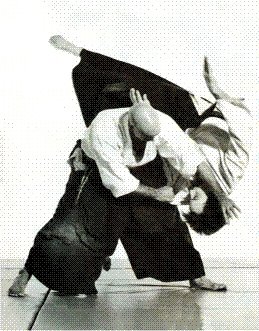
How hard is it to stand up every time someone crash you into the mat!!

Great to be back again in dojo!