Fallece Kuroiwa Sensei


Ellis Amdur publica una nota en su memoria en: In Memory of Kuroiwa Yoshio.
Descanse en paz, Kuroiwa Sensei.

Ellis Amdur publica una nota en su memoria en: In Memory of Kuroiwa Yoshio.
Descanse en paz, Kuroiwa Sensei.

The following is a brief compendium of the variety of attack characteristics, each designated by a descriptive title. After the explanatory paragraph, suggestions on appropriate aiki response strategies are given.
A freight train is coming straight toward you. It has a lot of inertia, and carries a lot of energy. If you're on the track in front of it, you're a target. This is the kind of thing you might expect from a drunk in a bar who decides to suddenly vent all of their anger at you.
Resolution: Get off the track and let it go by. You may decide to reroute the tracks or jump on board to direct the train, but the first priority is to get out of the way. Trying to stop it or reason with it will just get you run over.
Similar to the Ballistic attack, only this one is intelligent. Usually its trajectory carries less energy, but this means less inertia so it can turn and follow you wherever you move. And it typically carries an explosive warhead. Here we are talking about a mugger or rapist. Or in daily life, this could be an adversarial coworker who is plainly out to destroy you.
Resolution: Running and trying to dodge endlessly only drains your energy and plays into the heat seeker's strength. Stand still and calm (stay cool) and let it come to you. Step aside at the last instant and redirect the energy away from yourself or other innocents. Find a way to route the energy into the ground (any larger system that can fade the heat).
While smiling to your face, the subversive will stab you in the back. This usually entails a circular direction attack. Any time you feel off balance around someone, but you don't know why, there's a good chance you are involved with a subversive.
Resolution: Know yourself. Make sure you aren.t just being paranoid or insecure. Make sure criticisms directed or implied your way aren.t justified. Then try to expose the true nature of the attack so that it can be dealt with more openly. Example: "Marge, that's quite an outfit. I bet you saved a lot of money when you bought that... "You recognize the veiled insult and force Marge to be more honest or to back off: "I'm not sure what you're saying, Marge. Do you really like my outfit or are you just calling me cheap?"
Although there is very little energy in the attacks, they are very annoying and distracting nonetheless. In combat, the assailant is delivering a series of feints and jabs. In daily life, these are all the petty concerns that cumulatively can sap your strength.
Resolution: Realize the actual threat is minor. Don't spend more energy on something than it's worth. Swat them where you can but keep your mind focused on more serious concerns.
Anything that spends its energy to limit your freedom is an anchor. In combat, you are being restrained by an aggressor. An overly possessive parent or lover is a more mundane example.
Resolution: Keep your mind free. Struggling against the anchor weakens you and strengthens the anchor's hold. Relax and wait for an opening, realizing that you are taking the energy that it requires to maintain its hold.
Here, you get sucker-punched for no good reason. You innocently complement someone and they explode in your face.
Resolution: Learn to tread lightly, but still with confidence. Balance proper distance with intimacy, using the distance for safety (of both parties), and using intimacy for better knowing and understanding. Never get too close to someone without really understanding the area of involvement.
They lock onto you and won't let go. Unlike the anchor, they don't care about limiting your freedom as long as they can hold on and suck you 'till you're dry. They'll keep you on phone for hours, they'll take all your time, drain your resources, and then imply that however much you do isn't enough.
Resolution: Be generous but know your limits. It isn't their fault they keep taking if you keep giving. But if they take beyond your willingness (and ability) to give, treat them as you would a real leech: make a clean and careful cut with a razor blade. If it's large enough, then it's no longer a leech, it's a vampire. Time to sharpen that wooden stake.
Now, these are only some of the most basic forms that attack energy can assume. We can expect to encounter other forms, but they will probably be combinations of the above categories. For example, Ballistic + Mosquito = The Boxer; Mosquito + Anchor = The Wrestler. A Heat Seeker + Mine Field = Someone I Really Don't Want to Meet! It's useful to play with combinations of two and three basic attributes to see how they might add up, and then identify people or situations in our lives that fit the description. We also need to realize that attacks come in the form of people, situations, and our own emotions and desires. Attacks are rarely evil. They seem that way because of their potential for harm. Learning to deal with attacks as simple forces of nature allows us to maintain balance and respond in a rational manner.
In aikido, it is a foregone conclusion that we seek to avoid escalating the conflict, and hopefully the justification for that is self-evident. Where we add our own energy into the situation, it is usually to redirect it or transform it. One of nice things about energy, as opposed to matter, is that it is easily transmutable. Aikido strategy is optimized for handling attacks by transmuting them into more manageable form.
For example, if you are attacked by a mugger who is alternating Mosquito and Heat Seeker attack styles, you will have a problem if you stand there and spar with them. You are playing the game that they expect, and you are definitely escalating the conflict. By keeping ma-ai (proper distance), they will have to choose between letting you go or turning their attack ballistic. Once ballistic, you may then respond with any of the standard aiki-waza. I've seen too many aikido students get frustrated when they try to execute a kokyunage in a sparring type of encounter. They need to learn the patience and the skills necessary to draw their opponent into giving a more committed attack that is suitable for standard aiki defenses.
We are all very vulnerable beings. By understanding ourselves and the nature of things that can harm us, we may begin to develop the ability to recognize adverse situations that have been made familiar through training and discipline. Hopefully we can then create a set of tools which are simple yet effective in transforming our world into one which is increasingly less hostile toward us. This means we must first have a willingness to let go of our own hostilities and accept the changes to our own nature that are necessary for genuine living.

Mme. Jeanne Lieberman started learning martial arts at the tender age of 63, when most of us would prefer retiring from the armchair to the sofa- watching the antics of our grand children. But for her, it was the beginning of a new life- a life of conquering and self–discovery plus a whole new vista of opportunities and healing for a lot of people past 60. She had prepared herself though. She was a regular practitioner of Yoga. And she had-Inspiration-lots of it!
She joined a Judo Dojo (martial arts school) in Paris. When she went to enroll, the joke goes that the instructor asked if it was for her son or her grandson.
Imagine his surprise when she replied it was for her!Her astounding progress soon put an end to the apprehensions of her instructor and her younger classmates and she completed her black belt in sharp five years! Inspiration to her classmates!
She didn’t rest on her achievement, though. She went to Japan and started polishing up her Aikido skills that she had started learning in France. Aikido is a non-violent form of self-defense. She practiced under Master Tadashi Abe for four years before she secured her black belt in Aikido(!).
No, that is not the end of the story. At the age of 72, she started learning Kung fu (Wing Chun).She received her black belt in Kung fu at the age of 80, from Master Hoangnam at the famed Shaolin temple, China! Astounding Inspiration, isn’t it? To think how much an old lady would exert, pushing herself to the limits.
Her diet is very simple: a carrot for breakfast, an egg for lunch and a potato and a spoonful of honey for supper.
Mme Lieberman’s dedication paid off abundantly. She achieved such a level of prowess that she was able to perform unbelievable feats. She has demonstrated her prowess in several ways: In one demonstration she pinned a trained (black belt), 1.8 m tall, 200 kg athlete to the ground in less than one second and then repeated the feat nine times!
Pretty tempting skill to acquire isn’t it? This should be inspiration for young and old alike.
Mme Lieberman is not an aggressive person. Her personal philosophy is rooted in silence, tolerance, understanding and love.
She returned to Paris and started her own martial arts class. She developed her own synthesized style based on the three martial arts and Yoga. Most of her disciples are in their sixties or seventies. Some of them have had extraordinary experiences. One seventy year old student was attacked by two young muggers in the dark side alleys of Paris . She was able to ward off their attack easily and hold one of them in a paralysing arm lock, with him begging for mercy.
At a time when we keep hearing stories of estranged and isolated old people, who have been abandoned by their children, Mme. Lieberman’s story is heartening in that it gives inspiration to stand up for ourselves, dig into the resources within ourselves and prove to ourselves and the world that we can take care of ourselves, and much more!
Martial arts are a sure fire way to keep oneself fit and old age at bay. Martial Arts also help to maintain peace of mind and to develop suppleness of the body.
Martial arts are one of the best ways to spend ones excess time. Of course this statement would not appeal to the enthusiastic follower, who has dedicated his life to perfection in martial arts.
The lives of people like Jeanne Liebermann convey Inspiration in us to achieve all that we are capable of. They give inspiration to transcend our limits.
Existen cinco mentes o espíritus fundamentales en el Budo: shoshin, zanshin, mushin, fudoshin y senshin. Estos antiguos conceptos, sin embargo, son enormemente ignorados en los dojos modernos. El budoka que emplea el tiempo necesario para comprender las lecciones de estos cinco espíritus, madurará hasta convertirse en un artista marcial competente. El estudiante que no toma el tiempo necesario para aprender e interiorizar estos espíritus, sienpre estará falto de calidad en su entrenamiento.
El estado de Shoshin es el del espíritu del principiante. Es un estado de alerta que permanece siempre plenamente consciente y preparado para ver cosas por primera vez. La actitud de shoshin es esencial para un aprendizaje continuado. O'Sensei decía "No espereis que yo os enseñe. Debeis robarme las técnicas vosotros mismos". El estudiante debe jugar un papel activo en cada entrenamiento, empleando una actitud shoshin, para poder robar la lección del día.
El espíritu de zanshin es el estado de espíritu alerta. Se describe a menudo como un estado sostenido y enaltecido de alerta. Sin embargo, el verdadero zanshin es un estado de concentración antes, durante y tras la ejecución de una técnica, donde se conserva una conexión entre tori y uke. Zanshin es el estado de la mente que nos permite estar conectados, no sólo a un atacante, sino a múltiples atacantes e incluso a un contexto: un espacio, un tiempo, un evento...
El término original es "mushin no shin", cuyo significado es "el espíritu de la no-mente". Es un estado de la mente en el que no existe el miedo, la rabia o la ansiedad. A menudo se define mushin con la frase "mizu no kokoro", que significa "mente como el agua". Esta frase es una metáfora que describe la laguna que refleja lo que la rodea con calma, pero cuyas imágenes se desdibujan cuando un simple guijarro cae a sus aguas.
El estado de fudoshin se caracteriza por una mente inalterable y un espíritu inquebrantable. Es coraje y estabilidad, manifestados mental y físicamente. En lugar de indicar rigidez e inflexibilidad, fudoshin describe una condición que no es fácilmente alterada por pensamientos internos o fuerzas externas. Es capaz de recibir un fuerte ataque manteniendo la compostura y el equilibrio. Recibe y cede ligeramente, con las raíces bien plantadas, y refleja la agresión de vuelta a su origen.
Senshin es el espíritu que trasciende los cuatro primeros estados de la mente. Es un espíritu que protege y armoniza el Universo. Senshin es un espíritu de compasión que abarca y sirve a toda la humanidad, y cuya función es reconciliar la discordia en el mundo. Mantiene que toda vida es siempre sagrada. Es la mente del Buddha, y la percepción de O'Sensei de la función del Aikido.
Conseguir el senshin es esencialmente equivalente a la iluminación, y puede muy bien exceder el ámbito de la práctica diaria. Sin embargo, los cuatro primeros espíritus probablemente pueden ser obtenidos por el practicante serio a través de la alerta y el entrenamiento sincero. Obtener estos estados de la mente pueden beneficiar al estudiante de innumerables formas.
Shoshin puede liberar al estudiante de un frustrante proceso de aprendizaje, dándole la capacidad de discernir lo que no era capaz de ver con anterioridad. Zanshin puede elevar la percepción total del estudiante, mejorando la práctica de su randori. Mushin puede liberar la ansiedad del estudiante sometido a presión, mejorando su rendimiento en los exámenes. Fudoshin puede proporcionar la confianza para mantener la posición bajo atáques físicos desproporcionados. El budoka serio debe siempre encontrar formas de incorporar estos espíritus en su entrenamiento diario.
Todo sendero no se parece al otro. Siempre el sendero le corresponde al guerrero que le transita.
He visto gente caminando en el sendero, caer y desaparecer. He visto a otros caer levantarse y seguir caminado. He visto los que se pierden, otros que toman atajos que solo los llevan al principio.
También he visto senderos llanos y expeditos, algo anchos y tranquilos. Y los que más me han sorprendido son esos senderos pedregosos, angostos, maltrechos, los cuales llevan al mismo lugar que llevan todos y he visto a guerreros caminarlos sin frustrarse ni perderse.
Pero la visión más triste y desgarradora que he visto, es a los guerreros los cuales, el único obstáculo que se encuentran en la senda, es el de su propia sombra.
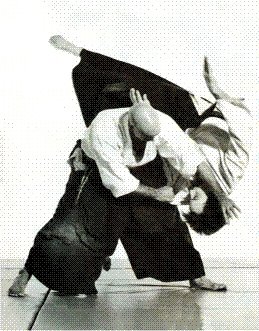 The Art of Aiki es la más completa fuente de información sobre el Aikido en Español. | Leer más
