Showing posts with label aikijujutsu. Show all posts

Minoru Mochizuki y Tadashi Abe

Rescatando un viejo tema de aikidojournal.com a colación de qué es Aikido y qué no lo es. Se trata de una anécdota ocurrida al Maestro Minoru Mochizuki concerniente al escepticismo de un joven Tadashi Abe. Enjoy:


Minoru Mochizuki, 10º Dan
Había un hombre llamado Tadashi Abe, recientemente fallecido. En cierta ocasión en que visité a O Sensei en al dojo de Iwama para saludarle tras mi regreso a Japón al finalizar la guerra [WWII], tuve el siguiente encuentro con él. O Sensei se encontraba feliz al saber que yo había regresado sano y salvo y me dio una calurosa bienvenida. Me quedé a dormir esa noche en el dojo. Esa noche vino a mi habitación un hombre de aspecto malvado con un corte de pelo a lo monje y me pidió permiso para entrar. Cuando le di el permiso él entró.

—“Me llamo Tadashi Abe. Sensei, ¿puedo hacerle una pregunta directa?”

Le dije que me preguntara lo que quisiera. Me preguntó si realmente estudiaba Aikijujutsu de manera seria. En aquellos tiempos el arte aun no tenía el nombre de Aikido. Cuando le respondí afirmativamente, me dijo lo siguiente:


Tadashi Abe, 6º Dan
—“¿En serio? Llevo mucho tiempo oyendo cosas sobre Vd., Sensei. He oído que ha tenido experiencia real en combate. Me parece extraño que alguien como Vd. Se encuentre satisfecho con un arte como el Aikijujutsu”.

Cuando le pregunté por qué pensaba así me contestó que ni Ueshiba Sensei ni el Sr. Morihiro Saito serían capaces de resistir un combate contra él ni siquiera tres minutos. Que él les derrotaría de un solo golpe.

—“Estás muy seguro de ti mismo, ¿no?”, contesté. “¿De verdad crees que puedes derrotar a Ueshiba Sensei?”, añadí.

Contestó que creía que sería fácil para él derrotar a Sensei y aun añadió:

—“He estado observando a Ueshiba Sensei durante mucho tiempo y no me convence practicar un arte como el Aikijujutsu. Estoy seguro de que le puedo derrotar con solo un golpe de boxeo. He oído que Vd. pone énfasis en el combate, ¿es cierto?”

Le contesté como sigue:

—“He estado en muchas peleas callejeras, pero no incluiría eso en la categoría de ‘combate’. Y también he asaltado campamentos enemigos sable en mano”.

Entonces me preguntó si realmente el Aikido era útil o no para pelear. Cuando yo le respondí que el Aikido no sólo era útil en peleas sino también en tiempos de guerra me dijo que mi respuesta no le convencía. Entonces le sugerí que me atacara y me quedé allí, indicándole que me atacara como mejor supiera. Me pidió que me pusiera en guardia. Le contesté:

—“No pidas cosas innecesarias. No hay manera de derrotar al enemigo si él le dice lo qué hacer. ¡Atácame como quieras!”

Abe murmuró: “Sensei, ¿realmente puedo golpearle? Es extraño… tiene aperturas por todas partes…” Entonces se puso en guardia y me atacó de repente. Esquivé el golpe [taisabaki] y le di una patada. Gruñó y cayó al suelo. Inmediatamente apliqué una técnica de resucitación [katsu] y le di un masaje.

—“¿Cómo puede alguien como tú, que se desmorona y pierde el conocimiento cuando recibe una pequeña patada, durar algo en una pelea?”

—“Sensei, ¿es que el Aikido incluye técnicas de pateo?”

—“¡Estúpido! ¿Qué quieres decir con esa pregunta? Empleamos técnicas de pateo o lo que haga falta. Incluso he empleado artillería. Las artes marciales, las armas y la artillería, todas son Aikido. ¿Qué es lo que crees que es el Aikido? ¿Crees que se trata de retorcer muñecas? Es un medio de Guerra… ¡una acción de Guerra! El Aikido es una lucha con sables de verdad. Empleamos la palabra ‘Aiki’ porque con él podemos sentir la mente del enemigo que viene a atacar, de manera que podemos responder de manera inmediata. Mira el Sumo. Cuando dan la voz [Miatte! Miatte!] se levantan y se lanzan el uno contra el otro en un flash. Eso mismo es ‘Aiki’. Cuando una persona se enfrenta a un enemigo estando en un estado mental libre de toda idea o pensamiento y es instantáneamente capaz de lidiar con él, a eso lo llamamos ‘Aiki’. En los tiempos antiguos se llamaba ‘Aiki no jutsu’. Así, la artillería o cualquier cosa de convierte en ‘Aiki’”.

—“¿Así es…? Creo que ya entiendo”.

—“Si aun no lo entiendes, ven a verme cuando quieras”.

Después de este episodio Abe me tomó miedo y me saludaba desde lejos. Pero cuando fui enviado [por Ueshiba O Sensei] a Europa me pidió que le llevara como asistente.

Durante mi tiempo en Europa también tuve experiencias interesantes. Como practicábamos cosas como luxaciones de muñeca algunas personas se preguntaban si este tipo de entrenamiento realmente sería útil en una lucha real y me hacían muchas preguntas, así que les di la siguiente explicación:

—“Cuando practicamos, aprendemos la manera correcta de mover el cuerpo y cómo emplear la fuerza [kokyu ryoku] de manera racional. Mediante el uso del ‘Aiki’ puedes ser capaz de responder inmediatamente en cuando un enemigo se acerca acechando para atacar. De esta manera puedes sacudirte de encima a cualquiera”.

Así que un estudiante me preguntó: “¿Entonces puedo traer una pistola? Si empleo una pistola, Sensei, ¿qué haría Vd.?”

Mi respuesta fue que entonces yo traería un rifle.

Aikido Principles

Just found this while surfing the web and thought it would be interesting to share.

Fudo Genri (Immovable principles)


Four points towards Body, Mind and Spirit unity...
  • Concentrate on seika tanden or center.
  • Mind, heart and body must relax.
  • Feel the Ki in any movement and extend it
  • Mushin (no mind, or stop thinking too much)

Kihon Genri (Basic Principles)


These are movement principles that follow the Aiki Law or Natural Universe Law.
  • Chushin: Center line. Always move from your own center line. Connect to uke and bring him into your center line. Do not move his center line separate from yours.
  • Shuchu: Focus power starting from the mind into the body.
  • Kokyu: Breath power, connecting the energy of the body and the physical aspects.
  • Enshin: Circular movement or more precisely, spiralling. You can spiral inwards or outwards.

Aiki Genri


Energy principles, essential in resolving conflict.
  • Awase: Blending, to harmonise with incoming force not to avoid or fight it. Body leads the mind.
  • Musubi: Connection, stage two of harmonising. Musubi can occur in many levels not just at the physical level. Mind leads the body.
  • Nagare: Fluid movement, there is no stop in movement or conflict. Joining with partners energy and moving synergistic-ally.
  • Takemusu Aiki: Unlimited manifestation of Aiki. This is a stage when you are living in harmony with the universe. Technique is not essential because your opponent cannot defeat you since he will be fighting himself.

Five Stages of Understanding Aiki

  • Aiki no Kokoro: Understand and belief within your heart the principles of Aiki.
  • Aiki no Genri: Know and understand the Aiki Principles.
  • Aiki no Waza: Embody the techniques of Aiki in training and life.
  • Aiki no Chikara: Resulting from training and embodiment of Aiki principles, achieve the power of Aiki.
  • Aiki no Seishin: True Aiki. Its 'switched on' without your active participation.

[Source: Aikihut]

Religion vs. science / TMA vs. MMA

Since I practice both a traditional martial art (aikido) and mixed martial arts, I often get caught up with lots of arguments and discussions about the relative merits of the two. It's a touchy subject, since experienced TMA practitioners are highly invested in their arts, and MMA practitioners often have TMA experience that they "outgrew", so personal bias comes into play a lot.

For me, the two are not competing against each other, they are orthogonal in their attributes, overlap some, and only become antagonistic when someone postulates an either-or scenario. This is very similar to debates about religion vs. science or faith vs. evidence.

First, let's get some definitions out of the way. For me, a traditional martial art is one that emphasizes martial artistry along with cultural and character attributes. They are generally very formal, have a rigid hierarchy (often denoted by titles such as 'master', 'sifu', and 'sensei' and colored belts indicating rank), and tons of splinter groups and off-shoots from "mainlines". Examples of TMAs include the various flavors of aikido; karate-do; judo; tae kwon do; kung fu; wing chun; and Brazilian jiu-jitsu. Most of these arts also claim to be extremely effective in self-defense situations and/or particularly lethal, an assertion based on their heritage and not on evidence.

Related to these are what I call "sporting martial arts". These are combat sports that are generally one-dimensional, have competitions governed by rigid rules, and often lack formal or culturally steeped rules of etiquette. Amateur wrestling, boxing, and, to a lesser degree, Muay Thai kickboxing are examples of this. Ironically these don't really claim to be strong for self-defense due to their one-dimensional nature, but their training methods make them surprisingly effective for that purpose. BJJ is a sporting art as well, but its roots are in self-defense and NHB fights so I don't put it in this classification.

A mixed martial art combines the techniques of multiple combat sports and martial arts, and eschews the rigorous rules of conduct and hierarchies typically seen at a traditional martial art. MMA practitioners train at a gym (not a dojo or kwoon), don't have a belt system, don't practice forms or kata, and work under a coach.

MMA arose in two big steps.

The first was Bruce Lee's introduction of the Jeet Kune Do philosophy, which discarded the dogma of "you train under one style only" in favor of "use those techniques which work, discard the rest". This was a revolutionary concept at the time (if you ignore a couple of the "ancient MMAs" such as aikijujutsu and ancient Greek pankration) and counter to the rigid mindset of so many traditional martial arts.

The second step, and quite possibly the most important, was the arrival of mixed martial arts as a sport, with organizations such as the UFC, Pride, Rings, various K-1 derivatives, IFL, Cage Rage, Rumble on the Rock, and so on providing fight cards and venues. This greatly popularized the sport of MMA and, at the same time, the notion of MMA as a martial art in its own right.

And it was about this time that the TMA crowd freaked the fuck out. To understand why, you need to realize that traditional martial arts typically do not have full contact sparring with "anything goes" type rules. Almost all TMAs require a uniform that is very unlike street clothes. Each style limits the techniques for sparring to emphasize that style's strengths. Almost all striking styles (tae kwon do, kyokushin, goju ryu, et. al.) disallow clinching, throws, or joint locks during sparring; often require heavy padding; and in some cases disallow many types of practical strikes (TKD doesn't allow knees or kicks to the leg; kyokushin does not allow punches or elbows to the face). Almost all grappling styles (judo and Brazilian jiu-jitsu) disallow striking during sparring.

There's nothing particularly wrong with all that, but these limitations mean that a style's effectiveness is a matter of faith. Too often bold claims were made about a particular style's lethality, i.e. "I could use these killer techniques but I'd maim you, so I can't spar". This is, not to put too fine a point on it, bullshit.

Why is it bullshit? Because, as Jigoro Kano (creator of judo) discovered almost 100 years ago, if you do not practice your techniques against a fully resisting opponent, then you have not mastered that technique. That is an absolutely unavoidable reality. If you possess some devastating joint break or nose smash or eye gouge or throat crush that you've never actually used it, then there's no way you can tell if it's effectiven (in absolute terms) and if you've really mastered it.

This is where many sporting martial arts (and judo, which is part TMA and part sport), developed a practical advantage, even with huge gaps in their curricula. A practitioner of a sport art competes against others on a regular basis, exposing them to opponents that do not want a technique performed on them. By using only techniques that won't kill someone, combatants can use their full repertoire at full speed and power.

This has a couple benefits. The first is that a student truly learns how to use a technique, under duress, and under less than ideal circumstances. This cannot be emphasized enough. The second is almost entirely intangible -- the student learns to deal with conflict and confrontation at high speed. Many TMAs train students using rote partner drills or unrealistic attack patterns (aikido's randori). The student's mettle is rarely tested against an attacker using skills or strategies outside that TMA's comfort zone.

A boxer may not be great at take downs or kicks, but he's usually very comfortable having someone trying to knock his head off. A wrestler may not have good striking skills, but he's used to someone trying to tackle him and slam him to the ground. Real world experience will trump theoretically dominant skill sets almost every time.

Now, MMA is the polar opposite of a TMA when it comes to the effectiveness of a technique -- it is purely evidence based. Faith doesn't play into it. Techniques are researched, developed, enhanced, and then tested in the crucible of a mat, ring, or cage. Techniques that simply do not work very well eventually fall by the wayside, so you have an accelerated evolutionary mechanism at work.

Over the past 15 years this has been strikingly evident in the MMA world. In the early days of the UFC you had Brazilian jiu-jitsu guys dominate using very rudimentary take downs and almost no striking skills. Over time wrestlers with superior take downs and take down defense, but sub par striking and submission abilities, started to dominate the scene. Then fighters like Fedor, BJ Penn, Wanderlei Silva, and GSP started showing up. They would use Brazilian jiu-jitsu submissions, wrestling take downs and take down defense, boxing punches, and Muay Thai kicks and knees.

MMA practitioners today are much, much different than those of even 10 years ago. An MMA fighter today probably still specializes in one domain, but he will be at least "good enough" in every other facet of the game or he won't be competitive. This is the evolution of MMA today.

MMA techniques and training regimens are based on evidence, not faith. You don't learn a technique with a master scowling at you saying "This will work when you need it, trust me!" If you can't pull off something, you won't use it, and you'll find out soon enough if you can pull it off.

TMAs, on the other hand, don't have the laboratory of no-holds barred competition with which to evolve, which is why, by and large, the goju-ryu or wing chun of today is nearly identical to that of 50 years ago.

TMA practitioners have their counterarguments when it comes to pure combat efficiency. The most common is that a TMA isn't a "sport" and thus is potentially more lethal. But as I discussed earlier, if you have a host of lethal techniques that you've never used against someone trying to beat the crap out of you, it's doubtful that you'll be able to use them when the shit hits the fan. The second most common, and ironic, argument is that a TMA is more effective "for real" since MMA competitions occur inside a regulated ring, wearing protective gear, minimal clothing, no weapons, and a well-defined one-on-one scenario.

This claim of "more realistic" would have a lot more weight if TMAs regularly trained in street clothes, wearing shoes, with weapons, against multiple opponents, and outside on concrete or inside on hardwood floors -- using a wide range of techniques. But they don't, making the argument specious at best.

So all that said, I must be pretty down on TMAs, right? NOT AT ALL! As I said at the beginning, I still practice a TMA (aikido) regularly. And here's why: MMA and TMA offer completely different things.

If you want to learn how to fight, then I do strongly believe than an MMA is going to be far more effective than any TMA in existence. It's faith vs. science -- I have evidence of MMA effectiveness and, more importantly, as I progress with MMA I can test my own abilities. It is true that MMAs are really optimized for fighting against someone who also has training, but I don't consider that a liability. Many TMAs are really setup to fight against others of their own style or against completely untrained opponents.

But not everything is about fighting. TMAs offer a host of valid benefits:

  • minimal but real exposure to history and cultural information
  • a feeling of learning an art form. For many people things like kata, practice drills, etc. are relaxing all on their own.
  • flexibility, strength, and cardiovascular improvement
  • relaxed environments where you can hang out and have a good time without feeling competitive pressure
  • a feeling of accomplishment based on your own advancement, not on your competitive ability

For some these benefits are absolutely massive. There are people that would be woefully uncomfortable wearing board shorts, rashguard, and mouthpiece while getting the shit kicked out of them. For your average house wife or mid-40s executive, something like tai-chi or wing chun or shotokan may be just what they're looking for.

An MMA practitioner poo-pooing those elements is missing the point entirely -- those features of a TMA aren't meant to appeal to an MMA practitioner hell bent on crushing the opposition.

If you want to learn how to fight, then MMA is the answer. But MMA training would leave a lot of people empty and cold, people who would otherwise find deep satisfaction with a TMA.

The analogy is religion vs. science. Religion doesn't make a lot of sense to a lot of people, and it may not be practical as a cure for cancer or your financial problems, but it's a source of wonderment, comfort, and camaraderie with like minded individuals. And this is what TMAs are like.

Science won't comfort you or tell you what you want to hear, but it will provide data in a measureble, repeatable format based on experiments and observed behaviour. It is up to you to draw what you can from MMA, but it cares not for your own needs. But you can rely on it to be fairly objective or, more callously, uncaring.

And as in the modern world, religion and science are not mutually exclusive, unless you choose to put them at odds with each other. TMAs and MMAs can coexist as long as you understand their roles and accept their limitations. And if you choose not to do both, that's great, but don't disparage the other because you're projecting your values onto something that isn't a good fit for you.

[Fuente: mma-journey.blogspot.com]

Official announcement from International Budo Seifukai

[The text below has been submitted by Patrick Augé Shihan]

September 15, 2009

To Whom It May Concern,

The purpose of this statement is to announce that after Master Minoru Mochizuki, founder of Yoseikan Budo, passed away, the Kokusai Budo Seifukai (International Budo Seifukai) was formed for the purpose of continuing and developing his ideals of education. These ideals are: to inherit and promote the principles of “Maximum Efficiency” and “Mutual Welfare and Prosperity” and to apply these concepts to the cultivation of character; to help youth develop physical and mental qualities; and to contribute to the improvement of quality in martial arts through the promotion of mutual friendship among its members, while deepening one’s appreciation of Budo.

Consequently, we divided the organization into three (3) regions. The directors of these regions are:

  • East Japan Operations Director, Nobumasa Yoshida Shihan, 9th dan
  • West Japan Operations Director, Tadashi Sugiyama Shihan, 9th dan
  • and International Operations Director, Patrick Augé Shihan, 8th dan

    In particular, all requests from overseas, such as notification of results of ranking examinations, applications for rank certificates and arrangements for seminars or training in Japan should first be made through Patrick Augé Shihan (auge@yoseikanbudo.com) who will inform the Hombu. Please understand that this procedure is for the purpose of maintaining the quality of ranks and the integrity of the organization.

    Moreover, the Yoseikan Hombu (main office) was moved to France and, the former Hombu Dojo in Shizuoka, Japan, was purchased by a third party. Consequently, the Seifukai is no longer practicing in that location. Also, please note that Mr. Terumi Washizu, from whom we could not get cooperation in regard to our requests, resigned from Seifukai.

    The present location of the Seifukai Hombu is the residence of Tetsuma Mochizuki Saiko Shihan, second son of Master Minoru Mochizuki.

    Hiroaki Kenmotsu, Shihan 8th dan was appointed Hombu Secretary.

    International Budo Seifukai
    Kyouichi Murai, 10th Dan, Chairman
    Tetsuma Mochizuki, Saiko Shihan

    Left to right: H. Kenmotsu; P. Augé; T. Sugiyama; T. Mochizuki: N. Yoshida; K. Koga.

  • △◯☐

    Breve recordatorio fundamental de la geometría del Aikido.

    O Sensei used these three principles to help his students better understand what they were learning. The Circle (marui), the Square (shikaku), and Triangle (sankaku) were used to illustrate the different concepts of movement and technique.

    Triangle: O Sensei used the triangle to illustrate the idea of water flowing. He said that water always took the path of least resistance, and this is what Aikidoka should be doing as well. An example of a triangle movement would be the irimi, or entering techniques. As a sword is brought down to strike, the Aikidoka steps in and to the side in order to position him/herself for the defense. If we look at a triangle as having two angles at the bottom and one at point, we can imagine the two lower angles representing a very firm, stable base, and the lead point being the Atemi. The triangle can be compared to the irimi (entering) techniques because it gives the impression of direct movement, without a turn or a Tai-sabaki, just a quick forward technique. Sometimes the direct responses to an attack are very effective, and are excellent for unbalancing your partner.

    "The body should be triangular, the mind circular.The triangle represents the generation of energy and is the most stable physical posture. The circle symbolizes serenity and perfection, the source of unlimited techniques. The square stands for solidity, the basis of applied control."

    – O Sensei

    Circle: Depending on your position and your opponent's balance, any technique can be executed from both the inside and outside of your partner's body. The circle comes from the japanese word Ju, meaning soft or gentle. The concept of Ju is the principle of pulling when pushed and pushing when pulled. We commonly hear the phrase "fight fire with fire", but I always thought that this was the opposite of the philosophy of Aikido. I think a more suitable phrase would be to fight fire with water. As circles we should never hit our opponent, no direct movements can be circles. The idea of the circle is to be like a ball, rolling with the attacks, usually by executing a Tai-sabaki to end up beside the attack. Being beside it effectively paralyzes the attack, because it is very hard to hit someone who is beside you and that close. When fighting directly, face to face, your opponent will have the opportunity to attack multiple times. After the first attack, being a circle, you should be beside him, but only for a moment, continuing his movement but still in control. Before the initial momentum of the attack has been spent, either while he's still committed to the strike, or as he's pulling back, recovering, this is the time to act, leading that movement into a technique. This is why many Aikido techniques look like the person receiving it is cooperating, they seem to be helping the person doing the technique, and in a sense they are. They give the opportunity and the strength, we merely guide them along the path until they are defeated, in effect by themselves. Circles are not stable in the stationary sense like the square, but they are stable in that they never fall. This is because they constantly move. Try to make a ball fall over... An example of the circular principle would be an attack from a sword. If the swordsman is committed to the strike, then the proper movement would be to lead him forward. If the attacker is holding back or recovering from the forward momentum of the attack, than a technique to his rear would be more effective.

    Square: But what if the attack is neither forward or backward? The theory behind a neutral attacker is to get him to move, possibly through an atemi (strike). This will destabilize his position and a technique may be performed. When O Sensei drew a square, he often wrote the word go, meaning strength. He said that since a square was made up of four ninety degree angles, the most effective strike would be at a ninety degree angle. The square is a very stable, very strong position, but it is unlike the triangle and circle in that it lacks movement. We often start off in a "square" frame of mind, being very calm and neutral. From here, if an attack comes, we can be very ready, and turn into a triangle and counter by entering, or by becoming a circle, to harmonize with the attack and put him down that way.

    These ideas of shape are simply to give the practitioner something easy to think about, a visual aid while practicing. Understand that the three shapes should not be restricting your thinking in any way, and don't worry if you can't identify which shape you should be. Also know that these shapes are constantly changing, never stick to any one. We can start a conflict in a square shape, moving into a triangle for an Atemi, and then into a circle to perform the technique.

    Recently I've been thinking a lot of this imagery, and during class I try to envision these shapes in their different states. Even during the warm-up exercises I can see the different shapes, and thinking of these while performing a technique is very helpful. Like an artist who is first told to reduce everything to geometric shapes, so do we. The triangle is very easy to see, usually associated with the stance, a stable yet directioned force. I noticed recently that the point of the triangle is often at one's center, and this makes sense, as this is the origin of all movements. The circle is also easy to see, I find it's usually the movement of the body and arms. Using the circle takes away the partner's chance to resist, because it's impossible to resist a force that can go any way, change instantly, surround you and control you before you really know what's happening. I have a hard time envisioning the square, as it is the most stable of the shapes, and not usually associated with the actual movements. It is the stability needed while in Kamae (ready stance), both physically and mentally. One must be physically grounded in order to produce an effective technique, and without the concentration, no matter how physically correct you are, the technique cannot work.

    “Comprehensive Yoseikan Budo book in English” by Edgar Kruyning

    This is to announce the publication of “The Art of Ju-jutsu,” the most comprehensive volume on Yoseikan Budo ever produced in the English language.

    Subtitled “the legacy of Minoru Mochizuki’s yoseikan sogo budo, a dynamic synthesis of modern and traditional martial arts,” this book gives the most detailed and authoritative review available of the unique art created by Minoru Mochizuki, one of the earliest uchi deshi of aikido founder Morihei Ueshiba, in his home dojo in Shizuoka City, Japan. It also gives extensive detail on the modern yoseikan budo of Hiroo Mochizuki, current international head of yoseikan budo, allowing the reader to find the commonalities and striking differences between the approaches of a father and son devoted to budo. Earning the following ranks since his beginning in budo at age 13 (turning forty this month), Edgar Kruyning is well-qualified, both physically and intellectually, to present the essence of Japanese martial arts:

    • 6th dan Judo
    • 6th dan Yoseikan-Aikido
    • 6th dan Ju Jutsu
    • 5th dan Yoseikan-Budo
    • 5th dan Iaido
    • 5th dan Aikibudo
    • 5th dan Kobudo
    • 2nd dan Karate

    “The Art of Ju-jutsu” reflects Minoru Mochizuki’s teaching that aikido is a form of ju-jutsu, which he considered a unique expression of Japanese culture to be preserved, developed and given to the world. “The Art of Ju-jutsu” is the best English resource available on the arts of yoseikan.

    Published by lulu.com, available on Amazon and elsewhere, “The Art of Ju-jutsu” will be a valued addition to any serious martial artist’s library. Densely illustrated with hundreds of high-quality photographs, the text provides rare insight into this important martial arts tradition. Preface by Patrick McCarthy.

    Sutemi Waza

    Many believe that sutemi waza has no place in Aikido. Well, Mochizuki Sensei didn't quite think like that, and incorporated a series of sutemi from his experience in Gyokushin Ryu Jujutsu into his Yoseikan. The result is a very nice blend of the sutemi with the aiki and ju principles of the art.

    The following are just two examples of Yoseikan sutemi waza. Hope you enjoy!

    Differences between Aiki and Ju

    Directamente de AikiWeb un interesante post de Chris Hein, de Central Valley Aikido, sobre la tan difusa diferencia entre Aiki (合気) y Ju (柔). Disfrútenlo.

    Chris Hein Sensei

    What is Aiki, how is it different then Jiu?

    It's pretty common knowledge that Aikido is the study of Aiki; but what is Aiki? Do people other then martial artists use Aiki? Is Aiki magic? Is Aiki science? Does Aiki exist? These are all very important questions to which many never get fulfilling answers.

    What is Aiki. Well first, lets look at the root words that make up Aiki. The first is Ai (合). Ai is the Japanese word for Accord, or meeting. It basically means to be in sync or come together with. The second word is Ki (気). Ki is the Japanese word for energy. Many people attach some mystical meaning to ki, but that will take us away from where we are trying to get to in this article. If for now you simply understand Ki as energy, the same as we use the word here in the west it will serve us well. By looking at these two words in conjunction we will get a very direct translation for aiki, of: in sync with energy.

    For myself, I look at Aiki like music. Several musicians playing music together must use Aiki. The energy is the sound they are producing, and the accord is them working together to produce a cohesive piece of music. Music is a very good example to use because there is no physical interaction, it is simply and directly related to the harmony of the energy produced (the sound).

    In my opinion an abstract example like this, is the clearest example of what Aiki is. Not to say that you cannot have Aiki when there is physical connection, but with physical interaction many other things may be things happening other then Aiki. This can cloud our understanding of what we will come to understand as Aiki.

    Do people other then martial artists use Aiki? Well as we have seen in our example above, yes, certainly musicians use Aiki, but others do as well. Another clear example of someone using Aiki would be an American Football running back. The running back is the guy often given the ball behind the line of scrimmage (where all the other players are fighting to get to the ball) his job is to run past all the other players on the line and try and make forward progress. Oftentimes you will see one or several players from the other team brake the line and attempt to tackle the running back. However a good running back, with just his intent and a slight move of his hips is often able to make the other players miss him, and even fall in the process.

    This is a "real life" example of what we in Aikido would call a "no touch" throw. The other players are trying so hard to get him, he convinces them that he will be in the place they suspect. Once he knows they are fully committed, he changes his direction and with out even touching them they will lose their balance and fall to the ground. This is not unique to Football, it can also be seen in soccer, basketball, and many other contact sports.

    In our two examples above Aiki is being used in different ways. One is using Aiki to make a perfect harmony with the other musicians, and the other is using Aiki for a more personally beneficial end, however both are allowing their actions to come in sync with another energy; Aiki.

    So how does one make Aiki? Active Aiki can only be achieved by allowing your mind to open to what is going on around you. Aiki is not a solitary practice, you must have something to harmonize with. What you harmonize with can be conscious or not, either way you can still achieve Aiki with it. However you can only "trick" an aware entity. For example if you are catching a ball, you will likely use Aiki. You will see the ball coming, and match the motion of the ball, so it lands softly in your hand. The ball is not conscious, however you still achieved an Aiki interaction with it. But the ball cannot be tricked, if you don't make contact with the ball it will follow it's natural path no matter what you do. Conscious entities can be tricked However. A bull for example, during a bull fight; the Matador can trick the bull into thinking things that are not true, and make the bull follow a new path. This is also Aiki, but used differently.

    The Aikidoka must allow his mind to open to his surroundings, and seek to blend with what is going on around him. He must seek to be in harmony with his environment by detecting not only the physical motion of random objects, but also the intentions of his fellow man and beast. Truly beautiful Aiki (for us who study Aikido) starts with understanding your partner's intentions, and what motivates his action. After this is understood, you must choose actions, yourself that coincide with his desires, and blend with him to make a perfect Aiki interaction.

    What is the difference between Aiki and Jiu? Depending on who you ask (particularly in relation to the styles that accompany the principals) you will get a multitude of different answers. These will range from the very mislead "Aikido is gentle and Jiu-jitsu is hard", to the overly simplistic, "they are basically the same thing".

    Personally I've always hated the translation of Jiu (柔) as soft. Soft is what I would call a cotton ball. Jiu is like an inflated beach ball. I wouldn't call a beach ball soft per say, but it's not hard either. It has give, but also structure; it's springy. It's not without resistance. A bow (as in bow and arrow) is another good example of Jiu, it has flexibility, but it's certainly not soft, a good bow takes plenty of force to pull. While Jiu is yielding, it is also stable and strong, like the branches of a healthy tree.

    Many people confuse the concept of Jiu and Aiki. While in physical interaction it's hard to tell the difference, they are still distinct principals, unique to themselves. Personally I would say the hard and fast rules are: Aiki is best used when you are not touching, and Jiu is best used with physical contact. In fact Jiu must have physical contact in order to be used. If you set a black inflatable ball next to a bowling ball, so they look identical, you would never know which one has Jiu (the inflatable ball) unless a physical force acted on it. Jiu is more receptive, and Aiki is more proactive.

    While it's not impossible to use Aiki while in physical contact it's less clearly seen, and harder to understand. If you watch film of Judo great Kyuzo Mifune, you can see he often use's Aiki to throw instead of Jiu. He will strike a rhythm with his partner, by beginning to prance a bit, and the second his partner falls into his rhythm, Mifune will throw him. This is a great example of using Aiki in physical interaction, but hard for someone with little experience to see.

    Aiki and Jiu are both present in Aikido as it is practiced today. While we call our art Aikido, it is not completely devoted to only the study of Aiki, but Jiu also. The deeper and more clearly we can understand the differences the more profound we can make our practice.

    Tezuka Akira Sensei passes away

    Luca Idolazzi Sensei from the Taki no Kan sent the following note to e-budo.com:

    Yesterday Tezuka Akira sensei passed away. He was one of the faithful uchi deshi of Mochizuki Minoru sensei and practised with energy at the old Yoseikan Dojo in Shizuoka. He strongly believed in Budo and tradition and preserved them through the years with his everyday practise. He continued Master Mochizuki's work in Shizuoka Yoseikan dojo with the Budo Seifukai. He left a big gap in Yoseikan tradition.

    Art of Deception

    In the May 2006 issue of Black Belt there was an interesting article and interview about Kondo Sensei. There's a box on p.88 with the following quote:

    Art of Deception

    Tokimune Takeda included in his lessons Aiki Kempo, the Kendo Kata, Ono Ha Itto Ryu and other techniques that had no relationship to Daito Ryu Jujutsu in order to avoid teaching Daito Ryu techniques. With something that is as basic as the Ikkajo series, he would modify the techniques so most students would never understand them. When he taught Ono Ha Itto Ryu —which involves cutting from a middle position to a high position and cutting through the person's entire body by putting all the power into the tip of the sword— he would explain it differently from Daito Ryu techniques. I had a question about this difference, and until that point, no one had asked him, I said, "Sensei, the things you are saying about the sword and Daito Ryu techniques are different."

    He was waiting for someone to question him. Tokimune would teach each person based on the level of the questions he asked. I learned at a higher level because of the questions I always asked. As a result of questioning him, he awarded me a kyoju dairi teaching certification in 1974, when I was 29.

    The Daitokan Dojo in Hokkaido would hold a yearly training event for all Daito Ryu Dojo in Japan. I would teach one group, and Tokimune would teach the other. The night before, I would ask him if I could teach the correct way of doing the techniques instead of not letting them know the right way. Tokimune would say, "No, teach it so they will not know or understand the right way of the techniques."

    — Katsuyuki Kondo

    Vídeo de introducción al Aikibudo

    Un bonito vídeo mostrando el Aikibudo de Floquet Sensei, un arte heredera directa del Yoseikan de Minoru Mochizuki. Se pueden ver tanto técnicas de manos vacías (nótense los sutemi marca de la casa y su clara herencia del Daito Ryu) como técnicas de armas de la Yoseikan Shinto Ryu, la interpretación de Mochizuki de la Tenshin Shoden Katori Shinto Ryu.

    Un excelente vídeo que da una bastante buena idea general del arte de Mochizuki Sensei, décimo dan Meijin.

    Cuando fuimos los mejores

    Para no olvidar quienes somos. Un video de recuerdo de los alumnos de casi una decada del que hoy es el grupo Nihon Kobudo Aragón.

    Ceremonia por el 5º aniversario de la muerte de Minoru Mochizuki Sensei en Shizuoka

    Los restos mortales de Mochizuki Sensei fueron trasladados a Japón el pasado abril y enterrados en el panteón familiar en su ciudad natal de Shizuoka el 25 de mayo de 2008, siguiendo los deseos del Maestro.

    La ceremonia, a la que atendieron familiares y estudiantes, fue seguida de la ceremonia ritual por el quinto aniversario del fallecimiento del Maestro en el Hotel Nakajimaya en Shizuoka.

    Teachings of Ueshiba Morihei Sensei

    O'senseiNathan Scott, from Tsuki Kage Dojo, has compiled the teachings of O'Sensei that can be found in the literature (of special importance are the texts written by O'Sensei himself) and put them together in his website for us to enjoy... and for some to be annoyed.

    The compilation can be found at http://www.tsuki-kage.com/ueshiba.html and contains quotes from "Budo Renshu" and "Budo" from O'Sensei, "Traditional Aikido" from Morihiro Saito, "Total Aikido" and "Aikido Shugyo" from Gozo Shioda, and "The Founder of Aikido, Morihei Ueshiba" from Kisshomaru Ueshiba.

    Ueshiba Morihei Sensei, founder of Aikido, has been often quoted and even more often written about by those that study Aikido. However, the choice of material quoted and discussed is almost exclusively in regards to his background or spiritual teachings. The following translations of his writings and lectures from the pre-WWII era are rarely acknowledged or discussed, and as such have been re-printed here to offer a bit of balance and perspective to those currently studying or researching Aikido.

    Demostración de Minoru Mochizuki

    Un vídeo interesante de un joven Minoru Mochizuki recién llegado a Europa.

    Curso multidisciplinar Nihon Kobudo Aragón (y 2)

    El curso impresionante. El trabajo de Kempo Fu Shih de Raúl Gutierrez fue de una velocidad, precisión y contundencia terribles. Aun no sé cómo se pueden dar tantos golpes en un sólo segundo. Se trabajó desde agarre de las solapas, desde jab y desde patada frontal.

    Del Aikijujutsu Yoseikan Ha con que nos obsequió el Maestro Miranda quedarnos con el control y la precisión de las técnicas. Trabajamos desde Mune Dori (con algún detalle histórico siempre interesante) y desde Ushiro Ryote Dori en progresión; desde el Te Hodoki hasta Ashi Tatami, pasando por el omnipresente Yuki Chigae. No sé qué me duele más esta mañana, si el Kabe Kake o el Ashi Tatami... Me lo pensaré a lo largo tdel día.

    Por la tarde Sergio Hernández nos hizo sudar de lo lindo con el Bo de la Yamanni Ryu. Y sí, el Bo era de 182cm de largo.

    Y para finalizar Pau Ramón mostró parte de las técnicas de intervención con Yubi Bo. Dolorosisisisimas. Seguro que se me bloquearon varios chakras. Tengo todo el ki en los dedos de los pies y no me quiere subir. Técnicas "sencillas" que requieren mucha precisión (cómo no) y derriban al más pintado.

    Curso multidisciplinar Nihon Kobudo Aragón

    Dejo aquí el cartel del curso, calentito, calentito...


    Es una gran oportunidad para trabajar con los Maestros, que os recomiendo no dejeis pasar.

    Doshu's Way

    A partir de una entrevista realizada a Ueshiba Kisshomaru para la Japan Martial Arts Society (JMAS) en marzo de 1986, Ellis Amdur extrae las siguientes conclusiones.

    Aikido starts as pure Daito-ryu (irimi-issoku), and then is rounded out, the opponent projected away rather than crushed or folded close in. In other words, you can't do aikido unless you can do Daito-ryu. Kamata Hisao describes Ueshiba Morihei's early aikido in Daito-ryu terms: "He always said, 'You must enter the opponent; get inside him and then draw him into you!'" This, by the way, is true ukemi on Ueshiba's part— fully congruent with the precepts of koryu, rather than the modern idea that ukemi is "taking falls."

    Amdur redunda, como hace siempre, en la imposibilidad de practicar el "do" sin haber dominado el "jutsu". Es decir, si no podemos realizar correctamente la técnica, de manera que el agresor quede controlado en todo momento, ¿de qué sirve realizar una bonita y fluída técnica circular? Como diría aquel, "para morir de forma grácil".

    No me puedo cansar de recordar que el Aikido es una evolución (no por supuesto la única) del Daito Ryu, y que no se puede evolucionar o desarrollar algo que no se conoce.

    Ueshiba Kisshomaru does emphasize here some elements of the basics of proper physical organization and alignment, but if that was enough, why didn't he - or any of the other top shihan for whom I took ukemi, both in kokyu ryoku yosei ho and in aikido techniques - manifest such power that we otherwise hear about? Perhaps because Ueshiba Morihei (and his compatriots in early Daito-ryu), as I have written over-and-over again, practiced basic breathing exercises, which one could also term kokyu-ho, which literally means "the method of breathing." "Kokyu-ryoku yosei-ho" means "the cultivation of breath power." This begs a question, because one can only further develop what one already has. Can we start with a two-person exercise that "refines" power, without developing such power first?

    Retorna al tema de la imposibilidad de refinar algo de lo que se carece. ¿Qué sentido tienen los ejercicios por parejas de kokyu ho, cuando no se tiene kokyu que desarrollar? Para eso hay prácticas, ejercicios, en los que no se require compañero; por ejemplo el tanren uchi, los suburi de ken y de jo...

    But, without barre work, no ballet; without scales, no virtuoso pianists; without juggling with the feet, no soccer; without prep work, no cordon-bleu. Without exhaustive solo training, no aikido? At least, no aikido of Ueshiba Morihei.

    O también: "sin (Aiki) jujutsu, no hay Aikido. No al menos el Aikido de O'Sensei."

    El artículo completo en: http://www.aikidojournal.com/?id=3600.

    IMAF Taikai 2007 at Cala Montjoi

    This year's Taikai at Cala Montjoi has been a complete success. The organization has been just perfect, and the location a good combination of sun, sand, sea and tatami.

    We counted with the presence of Jan Janssens (7th dan Aikijujutsu Yoseikan), José Guisado (7th dan Goshin Jujutsu), José Miranda (6th dan Aikijujutsu Yoseikan Ha), Pau Ramon Planellas (6th dan Nihon Kobudo), Juan Antonio Salas (5th dan Aikijujutsu Yoseikan Ha), David Buisán (4th dan Goshin Kenpo), Pere Soler (4th dan Mugai Ryu Iai Heido), Xavier Teixidó (3rd dan Aikijujutsu Yoseikan Ha), Miguel Ángel Ibáñez (3rd dan Aikijujutsu Yoseikan Ha) and others, among the Sensei. The best in their specialities.

    We could practice a full weekend of Aikijujutsu, Jujutsu, Nihon Taijutsu, Iaido, Iaijutsu, Aikuchi and other martial disciplines.

    I never step out of the "aiki tatami", where Senseis Janssens, Miranda, Salas, Ibañez and Teixidó did their best to try to teach us some of the techniques of their two different Yoseikan lines. Miranda Sensei's line, Yoseikan Ha, includes techniques from old schools, usually meaning Daito Ryu, but also Aikuchi, Jo Gatame, etc. We could say (or, at least it seems to me) that this line is more traditional and painful in its forms.

    Janssens Sensei's Yoseikan tends to be more dynamic in its application. Rich in Sutemi Waza, this line doesn't invest time in making complicated human knots with its ukes. Instead, tori gets rid of his ukes in a quite expeditive manner.

    I also attended the Aikuchi class by Miranda Sensei. Those expecting a class in Tanto Dori didn't get what they were ready for. In this work, it is tori who's welding the aikuchi (tanto without tsuba), and it is the aikuchi wielder who "wins" in the kata. A very interesting work, from a different perspective.

    Saturday night, the attending groups prepared an exhibition in honor of Javier Juarez Sensei, recently deceased. The Spirit of Budo was present all over it, with demonstrations of Aikijujutsu, Jujutsu, Kenpo, Iaijutsu, Nihon Taijutsu, Aikuchi, Jo Gatame, Tambojutsu, even some Hojojutsu... It was a very emotional moment.

    At the end, my whole body was acking for a complete day and night... But I loved it! Hope to see you all next year!!

    Shu Ha Ri

    “Shu-ha-ri” significa, literalmente, aceptar el Kata, diferenciarse del Kata y descartar el Kata. El propósito del entrenamiento en un ambiente Japonés clásico casi siempre sigue este proceso educativo. Esta aproximación única al aprendizaje ha existido durante siglos en Japón y ha sido clave en la supervivencia de muchas de las más antiguas tradiciones Japonesas.
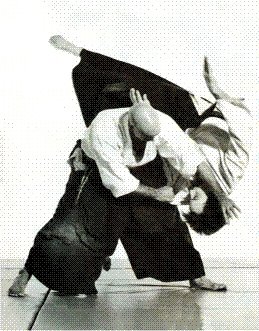
    Estas incluyen ámbitos tan diversos como puedan ser las artes marciales, la composición floral, él teatro, las marionetas, pintura, escultura y poesía. Si bien el Shu-ha-ri ha funcionado bien hasta la era actual, nuevas aproximaciones sobre el aprendizaje y la enseñanza están alterando este método tradicional Japonés de transmisión de conocimientos.

    El artículo completo, traducido por Óscar Recio, en http://www.aikidojournal.com/article?articleID=222&lang=es.
    Original version, by Yukiyoshi Takamura, at http://www.aikidojournal.com/article?articleID=222.

    Por cierto, que O'Sensei ya hablaba de esto cuando decía eso de "Entra por la forma y sal de la forma". Algunos se quedan únicamente con el "sal de la forma", sin comprender el proceso, sin crear una base sólida. Creo que es un mal muy extendido en el Aikido de hoy día. ¿Por qué no escuchamos a los Maestros como Takamura Sensei?