Curso Intensivo de Japonés

Tags : ,

Acabo de recibir el siguiente e-mail del gran Paco Barberán.

Aprovechad que es lo mejor que hay en Zaragoza (y yo diría que en España) para aprender Japonés!

Hola

¿Cómo va todo?

Te escribo para informarte de que este verano voy a impartir un curso intensivo (intensivísimo, diría yo) de iniciación al japonés en el Instituto de Idiomas de la Universidad de Zaragoza. Son un total de 60 horas lectivas comprimidas en 20 sesiones de 3 horas cada una. La finalidad, obviamente, es conseguir que al alumno le estallen las neuronas y constate con estupor que estudiar japonés a este ritmo, además de resultar "molto facile e divertente", puede generar también graves trastornos de la personalidad.

Bromas al margen, la información completa sobre el curso está en el link que te dejo aquí abajo con el ruego de que le des al contenido de este e-mail la mayor difusión posible: http://www.unizar.es/idiomas/cur_japones_za.html

Un fuerte abrazo.

Francisco Barberán
www.nichiza.com

Shakkan-Ho Conversions to Metric and Imperial Systems

Tags : ,

A useful utility to convert between old Japanese units (Shakkan-Ho) and the good old Metric and Imperial Systems.

Shakkan-Ho Metric System Imperial System
shaku (尺)
sun (寸)
bu (分)
  cm  inch
  

One shaku (尺) is approximately 30cm. One sun (寸) is about 3cm, while one bu (分) equals 3mm. As a curiosity, one ken is equivalent to 6 shaku (180cm), approximately the height of a man.

Even when Shakkan-Ho is the old system, it's still used in Japanese martial arts for measuring the length of weapons, as well as for clothing (in which case a bu corresponds to 3.79mm) and footwear (when it corresponds to 2.4mm.) In any case, one shaku always equals to ten sun; and one sun contains always ten bu.

Thanks to Leonard from www.network54.com forums and to Kampai Budokai for the good information and the JavaScript code.

Three Techniques That Have Everything

Tags : ,

O'Sensei once said that a student could learn all the basics of aikido if he practiced just three techniques: tai-no-henko, morotedori-kokyuho, and suwariwaza-kokyuho. Given the seemingly endless number of different waza and their variations, how is it possible to encompass aikido in just these three primary techniques?

Read the complete article at: http://traditional-aikido.com/Technique/three_techniques.htm

Katori Shinto Ryu: Warrior Tradition

Koryu.com has finally released the all too expected book on Tenshin Shoden Katori Shinto Ryu written by Soke Risuke Otake. For a long time, "The Deity and the Sword" has been listed for up to USD500 in some online stores, so for all of you that didn't want to spend that lot of money this is great news. This one-volume 336-pager is based on the earlier 3-volume work, reedited and redesigned, and for a much cheaper price.

This book contains a lot on history of the School, the techniques and the strategy for which it is famous. Some extra information about the more esoteric principles (such as the kuji in) can also be found in this great work.

More information at http://koryu.com/store/katori-shinto-ryu.html.

Shu Ha Ri

“Shu-ha-ri” significa, literalmente, aceptar el Kata, diferenciarse del Kata y descartar el Kata. El propósito del entrenamiento en un ambiente Japonés clásico casi siempre sigue este proceso educativo. Esta aproximación única al aprendizaje ha existido durante siglos en Japón y ha sido clave en la supervivencia de muchas de las más antiguas tradiciones Japonesas.

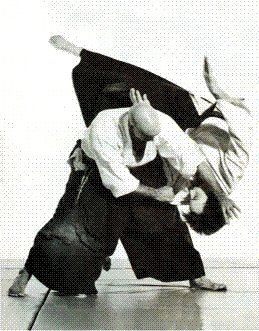
Estas incluyen ámbitos tan diversos como puedan ser las artes marciales, la composición floral, él teatro, las marionetas, pintura, escultura y poesía. Si bien el Shu-ha-ri ha funcionado bien hasta la era actual, nuevas aproximaciones sobre el aprendizaje y la enseñanza están alterando este método tradicional Japonés de transmisión de conocimientos.

El artículo completo, traducido por Óscar Recio, en http://www.aikidojournal.com/article?articleID=222&lang=es.
Original version, by Yukiyoshi Takamura, at http://www.aikidojournal.com/article?articleID=222.

Por cierto, que O'Sensei ya hablaba de esto cuando decía eso de "Entra por la forma y sal de la forma". Algunos se quedan únicamente con el "sal de la forma", sin comprender el proceso, sin crear una base sólida. Creo que es un mal muy extendido en el Aikido de hoy día. ¿Por qué no escuchamos a los Maestros como Takamura Sensei?

A Unified Field Theory: Aiki and Weapons

Tags : ,

Ellis Amdur published during last year, from March to October, a series of articles related to the origins of weapons training in Aikido. The following are the links to the original articles, eight in total, in the Aikido Journal website.

Ellis Amdur is the author of "Dueling with Osensei", "Old School" and the Instructional DVD "Ukemi from the Ground Up". You can reach him at his website at www.edgework.info.

Tantodori in Aikido

Tags : ,

"We are learning how to apply Aikido techniques when uke uses a dagger." I used to think that also. These days I’m not so sure. In most dojo that I have seen, tantodori takes shape tsuki kotegaeshi, tsuki rokkyo, tsuki gokyo, yokomenuchi gokyo, and ushiro kotegaeshi. Of course you see a few kansetsuwaza thrown in as well. That was fine for me in the beginning. But I realize now that there are two basic flaws in the way that tantodori is usually taught: they don’t take into account the way a person committed to cutting you would attack you, and they don’t take into account the way a person committed to not being cut would defend themselves. In Aikido, most tantodori is conducted with uke performing tsuki, shomengiri, yokomen or kesagiri while holding a wooden tanto. While these are common vectors that any attack may come from, they do not represent a sincere attack given the nature of the knife. An attack with the knife is all over the place. Slashing and thrusting in rapid succession is perhaps the most basic handling of the knife. Training to fight someone when armed with a knife is a most serious business, much more than an all-or-nothing, vector-based, yokomen or tsuki. The person with a knife knows that if their attack fails, that they will most likely be justifiably killed.

Read the complete article at http://www.aikidojournal.com/?id=3149.