Dojo Yaburi

Tags :

Hayashi took what may seem to Westerner's as an insane approach to choosing the Dojo at which to study. He would walk into the Dojo and challenge the Sensei to a fight. This, of course, incensed any students present at the time and they would insist on a chance to teach the chap a lesson themselves before their beloved Sensei would reduce himself to accepting a challenge from an upstart.

This practice, some might say brave, others foolish, is actually a time honored tradition in Japanese and Okinawan cultures. It is known as Dojo Yaburi (challenge). While not practiced frequently these days, it was actually a common protocol when Hayashi was a young man. The way it worked was simple. The man that issued the challenge must first fight the lowest ranking man at the Dojo. If the challenger defeats the man then he is granted the right to fight the next lowest ranking man, and so on until the challenger is defeated or has himself defeated the Dojo's Senpai (number one student). Then and only then is he allowed to challenge the Sensei himself, but is usually given the right to choose time and place as a reward for his previous efforts.

¿Por qué llamamos O'Sensei a Morihei Ueshiba?

Tags : ,

Lo siguiente no es de mi cosecha, sino que lo he resacado de Aikidojournal y de E-Budo. Todo el mérito es de Josh Reyer y de Peter Goldsbury y yo me dedico sólo a recopilar. Ahí va:

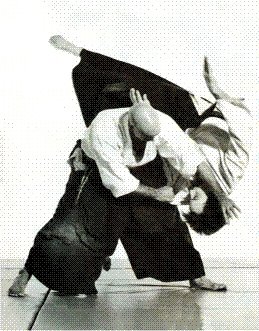
Morihei Ueshiba tenía tres títulos: O'Sensei, Kaiso y Doshu.

O Sensei (大先生):

Realmente es sin apóstrofe, aunque nosotros estamos tan acostumbrados a ponerlo que nos resulta dificil omitirlo. El primer kanji se lee /oo/ y significa "gran". Los dos últimos ya sabemos que significan "maestro". Así pues, O Sensei sería "Gran Maestro".

O Sensei (翁先生):

Vemos que el primer kanji cambia, pero se lee igualmente /oo/. Sin embargo, éste es un prefijo que se aplica a gente mayor y respetada. Este O Sensei sería algo así como "Venerable Maestro".

Kaiso (開祖):

Literalmente "fundador". En la biografía de O Sensei escrita por su hijo Kisshomaru, éste se refiere a su padre contínuamente como "Aikido Kaiso", aunque también como "O Sensei" (de las dos maneras). Parece ser que ésta es la forma que más utilizan los japoneses para referirse a Ueshiba: Ueshiba Morihei Aikido Kaiso (植芝盛平合気道開祖).

Doshu (道主):

Significa "guardián de la Vía". El equivalente al título inglés de "Headmaster", o "maestro principal". Este título es hereditario en el Aikido, de manera que Morihei Ueshiba fue Doshu en su día como luego lo fue Kisshomaru y más tarde Moriteru. El sucesor ha sido llamado tradicionalmente Waka Sensei (若先生), literalmente "joven maestro". Como curiosidad, en otras escuelas en lugar de Doshu se emplea el término (más utilizado) de Soke (宗家).

Evidentemente el Fundador no es llamado Doshu desde que murió, ya que el título pasó a su hijo. Por lo tanto, hoy día, sólo nos quedan dos formas (tres en japonés, dependiendo de cómo se escriba) de llamarle: O Sensei y Kaiso.

¿Servirá todo esto para embrollarnos aun más?

Aikido (nice & funny)

Tags : ,

Don't miss the chance to watch this video clip featuring Roland Hofman Sensei with U2 music!

Nice & Funy!

http://www.youtube.com/watch?v=zIJMhlrpfC8

Iwama and Yoseikan Training Night

January 11th we had an interesting training. People from Iwama Ryu and from Yoseikan training together can only bring extra insight for all of us...

Yes, it sure was a very short training, as it was mostly improvised and we ran out of time very fast, but it's good for a start; we'll do that more often.

Anyway, Iwama Ryu Sensei, Arturo Navarro, showed us some ken and jo suburis and the Roku no Jo kata done in 6 movements, then in 5, in 4 and in 3 movements.

Then, Yoseikan Sensei, Miguel Ibañez, performed mukae kubi shime sutemi. It's a beautiful sutemi with a very straight entry, so a big "Woooooohhhhhhh!!" was heared at the end. Big surprising movement.

After that, we all gathered for the theoric class, as we call it, in the surrounding bars and pubs. That was great as well! And fun, of course!

Differences in bokken shapes

Tags :

Originally published in IAIDO-L: http://listserv.uoguelph.ca/cgi-bin/wa?A2=ind0104&L=iaido-l&D=0&T=0&P=2096

Date: Thu, 5 Apr 2001 11:54:22 +0200
Reply-To: Japanese Sword Art Mailing List
Sender: Japanese Sword Art Mailing List
From: Hellsten Pasi
Subject: Bokken
Content-Type: text/plain

Hello,

I have a question about different models of bokken.

I have trained a little of Niten Ichi Ryu and also Ono-ha Itto ryu. These ryu use very different wooden sword. Niten bokken is very light and Itto Ryu's is quite heavy and shorter if compared to "regular" bokken.

What is the reason for this? Is it only an evolution of different ryu or is there some relationship for the real sword used in these particular ryu? Or is it just depending the way of using bokken in partner practice?

I am pleased to hear your opinion or if you can give me some referencies where to find more information of this matter.

Best wishes

--- Pasi Hellsten


Originally published in IAIDO-L: http://listserv.uoguelph.ca/cgi-bin/wa?A2=ind0104&L=iaido-l&T=0&F=&S=&P=2365

Date: Thu, 5 Apr 2001 09:27:31 -0400
Reply-To: Japanese Sword Art Mailing List
Sender: Japanese Sword Art Mailing List
From: Kim A Taylor
Subject: Re: Bokken
In-Reply-To: <9c8d850e853cd41193e30000e2204a7d2cf16c@muikku2.huch.fi>
Content-Type: TEXT/PLAIN; charset=US-ASCII

There is quite a difference in bokuto between some schools, and I suspectmost of it is due to the way the schools use them in practice since I haven't seen much difference in katana to speak of, although some are beefy, some light, some long and some short so perhaps there is more variation than I give them credit for.

From my observations on making bokuto over the years I've noticed that for those that are curved, the curve is roughly the same, if you take all my patterns for bokuto such as niten ichi-ryu, kendo no kata, shindo muso-ryu, iwama aiki-ken, and what have you, and put them together the curves actually lay over one another pretty closely.

The lengths vary by an inch or two but not all that much.

The Niten Ichi-ryu blades are 3/4 of an inch thick (1.8cm) rather than the usual 1 inch (2.5cm) and I think that's mostly due to the way they're used in practice, trying to hold a regular sized daisho out at arms length and shoulder height for a 2 hour practice would cripple most people.

Haven't seen an Itto-ryu bokuto but the Kashima Shinryu bokuto is pretty beefy and straight, the blade is about 1 1/8 inch thick. I suspect it's that way because the school has some exercises that, as done by a beginner, would snap a regular bokuto in half. The potential for full-on edge to edge "baseball" swings at full power is there for sure.

The Shindo Muso-ryu bokuto tends to be a bit thinner at the tip than someother designs which would make it a little easier on the jo as it comes over to strike down the bokuto in hiki otoshi uchi, not as much chance of meeting the tip dead on and gouging out a chunk of the jo or splitting the tip of the bokuto. The SMR bokuto also tends to be a little bit (not alot) more straight than say, the kendo no kata bokuto, which encourages the bokuto holder to tilt the wrists up a bit more to take the kamae. This puts the tsuba into a better position to protect the wrist should the jo come sliding down too far. The thinner tip also makes it easier to move aside with the jo.

The kendo no kata bokuto often has a more rounded "tsuka kashira" than other styles which may feel a bit more natural in a kendoka's hands than the oval shape of most other bokuto.

The Bugei catalog shows bokuto that have massive long hilts, and this is obviously to match the long hilts that the Yanagi-ryu use on their blades.

So I think that if you look at how a school practices their techniques, and you then look at the bokuto you'll find a reason for the variations, and why not? Bokuto are "disposable" training tools and so should be made to fit the practice, whereas swords are a bit more standardized (maybe it's easier to convince the local carpenter to do a different shape than it is to convince the famous smith?? ;-)).

--- Kim A Taylor


Originally published in IAIDO-L: http://listserv.uoguelph.ca/cgi-bin/wa?A2=ind0104&L=iaido-l&amp;amp;D=0&T=0&P=2641

Date: Thu, 5 Apr 2001 11:12:34 -0400
Reply-To: kfriday@arches.uga.edu
Sender: Japanese Sword Art Mailing List
From: Karl Friday
Subject: Re: Bokken
In-Reply-To: <9c8d850e853cd41193e30000e2204a7d2cf16c@muikku2.huch.fi>
Content-Type: text/plain; charset="us-ascii"; format=flowed

It's purely a matter of ryuha preference. Different schools use different sorts of training tools, because each is after tools consistent with its own techniques, training practices and philosophies. Nitten Ichi-ryu does a lot of stuff with one hand or with two swords, so they use light bokuto to facilitate this. Itto-ryu is into power, so the heavier bokuto facilitates building muscle and strength. Kendo bokuto (which is probably what you're thinking of when you say "regular" bokken) are curved and relatively light, because their main purpose in kendo training is to duplicate the feel of a real sword cutting (vs. the cylindrical shinai used for other kendo training). Kashima-Shinryu bokuto are medium weight, straight, and feature heavy wooden tsuba, because we bang them together at full power (and a curved bokuto would break), and because the system emphasizes quick change-up movements that would be compromised by a heavier stick.

There is sometimes some connection between the style of bokuto used by a ryuha and the style of sword preferred by its members, but it's most likely the reverse of what you're probably asking about. That is, ryuha didn't develop bokuto to match the lighter or heavier swords preferred by their early proponents; people who train in a particular school naturally tend to prefer swords that feel more like the bokuto they're used to.

--- Karl Friday

Searching for The Essence

Tags : ,
In 1927, one man would change all that. Morihei Ueshiba, a deeply spiritual human being and highly skilled martial artist, began to refine these methods, combining jujutsu, fencing, and spear fighting. It was Morihei Ueshiba who would name these methods Aikido and transform this martial art into spiritual lifestyle that would be embraced by men, women and children around the world. At its core, Aikido is about harmony. It is primarily a defensive art that utilizes your opponent's own anger and energy against him. The idea, when possible, is never to truly harm your attacker, but subdue him - in essence, creating harmony between you and him.

Click here to read the complete history.

How to make a paper shuriken

Tags : ,

You can find in the image below how to make an origami shuriken (actually a shaken). Please, have some fun, but don't throw it to other people.

If you begin with two A4 paper sheets, you will end up with a 120mm diameter - 4 blades shaken.